
 Zoe Nora
Your heart beats over 100,000 times every day. This steady rhythm shows how nature uses repeating cycles to work. We see these patterns in refrigerator hums and complex signals that power our smartphones.
At its core, frequency shows how often an event occurs during a set period. We can measure biological pulses and electronic oscillations to understand the world around us. With frequency analysis, we turn unseen vibrations into useful data.
Sound offers a clear way to see this idea. People usually hear vibrations from 20 Hz to 20 kHz. This audio spectrum gives us a useful starting point for exploring how Frequency shapes music, biology, and modern wireless technology.
Key Takeaways
- Repeating events define the rhythm of our physical world.
- We measure these cycles to understand complex systems.
- The human ear perceives sound between 20 Hz and 20 kHz.
- Data patterns reveal hidden information in signals.
- Mastering these basics improves your grasp of modern technology.
What is Frequency?
Frequency shows how often events repeat in daily life. It counts cycles, oscillations, or events during a set time. We use it to study a runner’s heartbeat or a guitar string’s vibration.
Definition of Frequency
In science, frequency means the rate of a repeating event. It differs from period, the time needed for one cycle. Wavelength measures the distance between wave peaks, while frequency measures motion over time.
We must also separate frequency from amplitude, which shows a wave’s strength or height. In sound, people often confuse frequency with pitch. Pitch is our personal sense of high or low sound, but physical frequency sets it.
“The universe is not made of things, but of vibrations, and frequency is the key to unlocking that rhythm.”
Significance in Various Fields
In digital marketing and SEO, we study keyword frequency to see how often a term appears in text. This keyword frequency helps search engines judge whether content matches a user’s search intent.
Audio engineers divide the spectrum into ranges to control sound quality. These ranges include:
- Sub-bass: The lowest range that provides physical impact.
- Bass: The foundation of rhythm in music.
- Mids: Where most human vocals and instruments reside.
- Treble: The high-end frequencies that add clarity and detail.
These distinctions help us interpret data, improve content, and value the signals around us. Learning how frequency works across fields connects theory with practical use.
Types of Frequency
Frequency appears in many forms, from machine pulses to invisible waves carrying digital data. These categories help us use frequency tracking to monitor motion, signal cycles, and changes over time.
Mechanical Frequency
Mechanical frequency measures how often a physical object oscillates or vibrates. We often see it in industrial settings, where rotating machines create movement patterns. Consistent monitoring supports predictive maintenance.
Engineers use frequency tracking to find problems in motors or turbines before failure occurs. They can identify worn parts through each component’s unique vibration signature.
Electrical Frequency
Electrical frequency measures the cycles per second in an alternating current (AC) signal. In the United States, the power grid runs at 60 Hertz. This steady rate supports reliable household appliances and industrial equipment.
We use frequency tracking to keep power systems synchronized and efficient. A change from the standard cycle may show a load imbalance or electrical fault.
Acoustic Frequency
Acoustic frequency describes vibrations traveling through a medium, such as air, to create sound. These waves range from low rumbles to high tones in human speech and music. When we explore the best deep bass settings for an amazing audio, we adjust acoustic frequency to match our preferences.
Whether studying environmental noise or tuning music, frequency tracking helps us map sound waves accurately. Precision in measurement helps separate tones and improve audio signal clarity in many applications.
Units of Frequency
Precise units help us compare wave behavior across fields. Without a universal standard, comparing experiments or audio equipment would be nearly impossible. A shared language helps us report findings clearly and accurately.
Hertz: The Basic Unit
The standard unit for measuring cycles is the Hertz (Hz). One Hertz means exactly one cycle per second. For higher rates, prefixes simplify numbers; one kilohertz (kHz) equals one thousand cycles per second.
To understand this, consider human hearing. We may describe a high-pitched sound as 20 kHz, which equals 20,000 Hz. Correct units matter for any frequency measurement task, in a lab or home studio.
“Mathematics is the language with which God has written the universe.”
Conversion Between Units
Consistent units help us compare scientific or audio readings. If one source gives Hz and another gives kHz, convert both to the same base to avoid errors. Multiply by 1,000 to convert kilohertz to Hertz.
During frequency measurement, we use frequency tools to keep data reliable. These instruments help us visualize and verify the oscillations we study. Common options include:
- Calculators for quick unit conversions.
- Spectrum analyzers to visualize signal distribution.
- Signal generators for creating precise test tones.
- Digital measurement software for real-time analysis.
By mastering these frequency tools, we better understand how waves work in daily life. Accurate measurements remain the cornerstone of modern technology and scientific discovery.
Frequency in Physics
Wave motion reveals hidden patterns in light, sound, and matter. By watching energy move through different mediums, we learn basic laws of the universe. Through frequency analysis, we decode complex signals and better understand the world.
Wave Motion and Frequency
Wave motion shows how energy travels from one point to another without moving the physical medium. Each wave has a wavelength, propagation speed, and time for one cycle. Frequency is the inverse of this period, showing how many cycles happen in one second.
Measuring cycles tells us how fast a wave oscillates. Fast propagation often links to certain wave behaviors in mechanical and electromagnetic fields. Tracking oscillations helps us predict how waves meet obstacles or change in different materials.
Frequency and Energy
Oscillation rate connects closely with the energy a wave carries. In many systems, higher frequencies mean higher energy, but this depends on the wave’s context. Frequency analysis breaks complex sounds into their basic parts.
When we hear a musical instrument, we hear a fundamental tone with higher overtones. These overtones define the timbre, or sound quality that makes a piano different from a violin. Frequency matters, but amplitude and phase also shape the full range of natural phenomena.
Frequency in Music
When we hear favorite songs, we hear a precise series of mathematical frequencies. Our ears turn these fast vibrations into pitch. Using specific frequency tactics helps us understand how sounds create music’s emotional landscapes.
Musical Notes and Their Frequencies
Each musical note matches a vibration rate measured in Hertz. For example, a bass guitar’s low open E string vibrates at about 41 Hz. This low foundation adds warmth and depth to a musical arrangement.
Musicians and producers use different frequency tactics to shape each sound’s character. They study the fundamental frequency and its overtones. Then, they adjust the mix for specific results:
- Clarity: Removing muddy low-mid frequencies to let instruments breathe.
- Brightness: Boosting high-end frequencies to add shimmer and detail.
- Harshness: Taming resonant peaks that cause listener fatigue.
Understanding Octaves
An octave links two notes when one frequency is twice or half the other. For example, a 100 Hz note has a 200 Hz note one octave higher. This steady pattern makes octaves sound harmonious to the human ear.
Understanding these relationships is an essential frequency tactics skill for audio engineers. Balancing octaves helps music sound full and professional on different playback systems. Whether mixing a track or learning an instrument, these patterns help control your work’s overall sonic balance.
The Role of Frequency in Technology
Invisible signals travel through air and power our global communication networks. When we send texts or stream videos, precise frequency management helps data reach its destination without errors. Engineers assign specific ranges to services, preventing interference and maintaining high-quality connections.
Telecommunications and Frequency
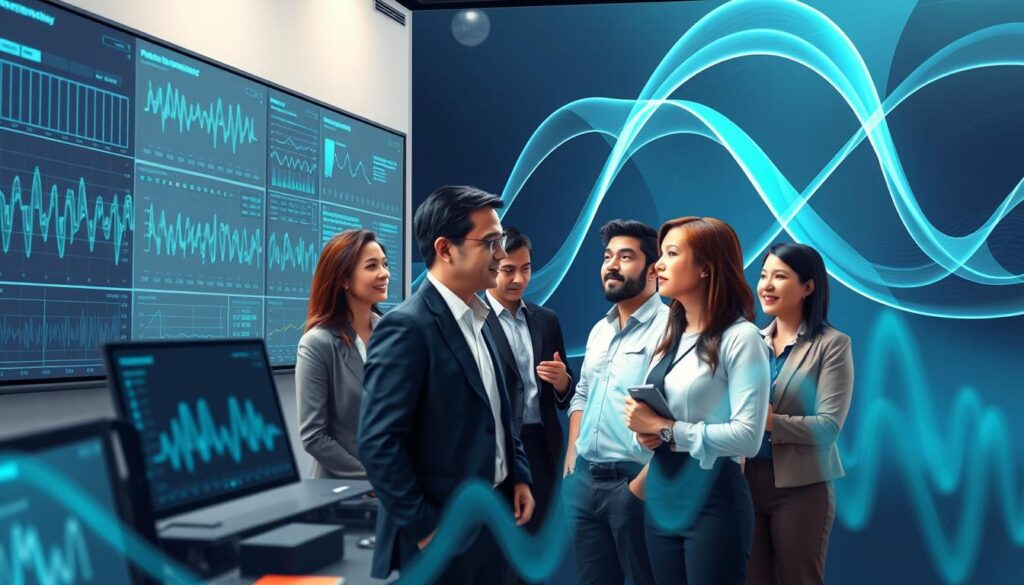
Telecommunications systems use a carrier frequency to transport information over long distances. We use modulation to encode data onto these waves and improve efficiency. This process protects signal quality while millions of users share the limited spectrum.
Bandwidth is a channel’s capacity, determining how much information can travel at once. Effective channel management reduces signal overlap. This planning supports modern frequency optimization, keeping devices connected in crowded environments.
Frequencies in Data Transfer
In the digital realm, technical metadata, such as bitrate and channel format, shows how audio and video files are structured. Higher bitrate often needs a wider frequency range to preserve fidelity during transmission. frequency optimization balances high-quality data with network infrastructure limits.
This table shows how modern technology uses different frequency ranges to manage data flow and signal reliability:
| Frequency Band | Primary Application | Data Capacity | Signal Range |
|---|---|---|---|
| Low Frequency | Radio Broadcasting | Low | Very Long |
| Mid Frequency | Mobile Networks | Medium | Moderate |
| High Frequency | Wi-Fi and Satellite | High | Short |
Ultimately, the goal of frequency optimization is to provide a seamless experience for the end user. As we innovate, our ability to manage these invisible waves will shape the future of global connectivity and digital speed.
Frequency and Everyday Life
Frequency shapes daily life, from morning commutes to signals that power our phones. We often miss these patterns, but they guide many parts of modern life. Tracking workout steps or studying SEO frequency shows how often events happen.
Frequency in Daily Activities
Our lives follow repeating cycles that create structure and predictability. When we speak, our vocal cords vibrate at set rates, creating acoustic frequency. Exercise also depends on consistent repetition, including jogging and lifting weights.
These patterns help us use effective frequency tactics in personal habits. Knowing how often we do tasks can improve our use of time and energy. Digital marketers use data in similar ways, linking physical movement with digital analysis.
From Radio to Wi-Fi: Frequency Applications
Technology uses electromagnetic waves to carry information across great distances. A radio receives broadcasts when it tunes to a station’s specific frequency. Wi-Fi routers send data through fast-changing electromagnetic fields, keeping us connected wirelessly.
Physical signal frequency describes waves and cycles, while SEO frequency tracks repeated keywords or content updates that influence search rankings. Both fields need careful monitoring to produce the desired result. Mastering these frequency tactics helps us manage modern technology and information.
The Importance of Frequency in Biology
Understanding our body’s internal timing reveals life’s hidden order. Our bodies follow repeating events that help keep us healthy and alert. With frequency tracking, we can watch these patterns over time and better understand our well-being.
Heart Rate and Frequency
The heartbeat is the best-known biological frequency. We measure it in beats per minute, a clear sign of cardiovascular effort. With frequency tracking, we can see how the heart responds to exercise or stress.
This data supports observation, not medical diagnosis. By tracking these pulses, we can set a baseline for our fitness level. This baseline helps us choose when to work harder or rest during a workout.
Circadian Rhythms
Our bodies also follow slower cycles called circadian rhythms. These internal clocks guide sleep and waking across a roughly 24-hour period. Consistent frequency tracking of daily habits helps us match schedules with these natural needs.
For example, we can plan demanding tasks during our most alert hours. Watching when we feel most productive helps us build a daily routine we can sustain. This method helps us manage energy without rigid outside rules.
| Biological Event | Measurement Unit | Typical Cycle Duration |
|---|---|---|
| Heartbeat | Beats Per Minute (BPM) | Less than one second |
| Breathing | Breaths Per Minute | 3 to 5 seconds |
| Circadian Rhythm | Daily Cycle | Approximately 24 hours |
Ultimately, frequency tracking is a powerful tool for self-awareness. By monitoring heart rate and adjusting sleep schedules, we learn to hear our body’s rhythms. This practice supports a balanced, informed approach to daily life.
Measuring Frequency
Mastering the art of frequency measurement connects raw data with useful insights. Engineers and hobbyists can track cycles in electrical currents or sound waves.
Reliable results require the right equipment for each task. High-quality frequency tools keep data consistent and accurate in different environments.
Instruments Used for Measurement
We use specialized devices to capture oscillation data from different signal types. Each instrument offers benefits for specific applications:
- Frequency Counters: Ideal for high-precision counting of periodic signals.
- Oscilloscopes: Essential for visualizing waveforms and measuring the period of a signal.
- Spectrum Analyzers: Used to break down complex signals into their individual frequency components.
- Digital Audio Workstations (DAW): Perfect for analyzing recorded sound and audio-based oscillations.
Common Methods of Measurement
The signal’s nature guides our choice of method. For simple, repeating signals, direct cycle counting offers a clear path to frequency tracking.
For complex or noisy signals, spectral analysis reveals dominant patterns. The table shows how each method meets specific technical needs:
| Method | Best For | Key Benefit |
|---|---|---|
| Direct Counting | Electrical signals | High accuracy |
| Waveform Analysis | Vibration tracking | Visual verification |
| Spectral Analysis | Audio/Radio | Detailed breakdown |
Every method requires careful calibration and suitable sampling rates to prevent errors. Repeated readings help keep our frequency tracking dependable over time.
Clear units and consistent frequency tools help us interpret the oscillations around us.
Frequency Analysis in Data Science
Raw numbers show results, but frequency analysis adds context for complex information. By studying occurrence rates, we can find hidden patterns that standard metrics may miss. This process turns chaotic datasets into clear, useful insights.
Importance in Data Interpretation
Data interpretation depends on spotting repeated values and seasonal behavior. By tracking how often data points appear, we can find clusters and unusual changes that signal anomalies. These findings help predict future trends and maintain system health.
In text analytics, we use keyword frequency to find a document’s main topics. SEO frequency shows whether content matches user search intent without unnatural repetition. Context matters most when we assess these measures.
Common Techniques Used
Effective analysis uses several mathematical and visual tools. These methods break complex signals into useful ranges, much like an audio chart separates sound waves. The table lists reliable techniques for our daily workflows.
| Technique | Primary Use Case | Data Insight |
|---|---|---|
| Histograms | Distribution analysis | Identifies data clusters |
| Fourier Analysis | Signal processing | Extracts periodic cycles |
| Time-series Decomposition | Trend forecasting | Separates seasonal patterns |
We use frequency analysis to keep our models accurate and relevant. These techniques help separate random noise from important signals. This careful approach grounds our interpretations in solid evidence instead of guesswork.
Future Trends in Frequency Research
We are entering a new era where signal processing shapes our daily lives. Mastering wave patterns helps improve medical diagnostics and global connectivity.
Emerging Technologies
Advances in super high frequency communication show how quickly modern infrastructure is changing. Companies like Ericsson and Thales lead deployments of strong networks using precise signal management. Machine learning and smarter sensors are vital for tracking complex data streams in real time.
Potential Innovations and Discoveries
Frequency optimization remains central to progress as we add more devices to our digital ecosystem. We must use smarter frequency tactics to meet the rising demand for high-speed satellite links and radar systems. These methods keep our wireless world stable while supporting massive data growth.
When we apply these concepts responsibly, we gain deeper insights into biological rhythms and physical phenomena. Our journey to understand these invisible waves continues to drive innovation across every major industry.