
 Zoe Nora
Did you know over 80% of Western music uses the same symbols for pitch? These symbols might seem like a secret code to many. But, they are the key to understanding music theory.
Learning these basics is like finding a bridge to melodies. Knowing the treble clef is a big step. It helps us arrange high notes clearly on the page.
We aim to make learning music easy for everyone. Even if you’re new, you can start with confidence. Let’s dive into how this symbol shapes music reading and playing today.
Key Takeaways
- Music theory acts as a vital bridge for understanding melody and rhythm.
- The clef system allows musicians to decode symbols used for centuries.
- Learning the basics helps beginners read notes with greater accuracy.
- This guide simplifies complex concepts for those with no prior experience.
- Mastering these fundamentals builds a strong foundation for any instrument.
Understanding Treble: A Basic Definition
Ever wondered why some notes sound light and airy while others feel heavy? That’s because of treble. Treble refers to the higher-pitched notes that add brightness and clarity to music. In written music, we see the treble clef, which has an ornamental letter G on the left side.
What Does “Treble” Mean?
The term treble describes a specific range of high-pitched notes. These notes are in the upper register of instruments like the violin or flute. Because they are shorter and faster, they stand out in music, carrying the main theme.
“Music is the shorthand of emotion, and the high notes are the voices that sing our most delicate feelings.”
Why Is Treble Important in Music?
These frequencies help create the melodic lines we often hum along to. Without them, music would lack definition, making it hard to distinguish a catchy tune. By focusing on the treble range, composers keep the melody at the forefront of our experience.
How Is Treble Different from Bass?
The upper register adds sparkle, while the bass range provides the low-end support that anchors the rhythm. Knowing this difference is key for any student learning about sound. The table below shows the main differences between treble and bass.
| Feature | Treble | Bass |
|---|---|---|
| Frequency Range | High pitch | Low pitch |
| Primary Role | Melody and clarity | Rhythm and foundation |
| Visual Symbol | G-Clef | F-Clef |
| Emotional Impact | Bright and energetic | Deep and stable |
The Role of Treble in Music Composition
Looking into music theory, the upper frequency range is key for creativity. Composers use these high notes for clarity and direction. They pick note places to shape a piece’s character.
Treble in Melody and Harmony
The treble range is where melodies live. Our ears prefer higher sounds, making the main theme stand out. This creates a clear sound order.
This range is also crucial for complex harmonies. Musicians add brilliance and texture to chords with these notes. Here are some ways to use them:
- Layering high-frequency instruments to thicken the sound.
- Using counter-melodies to weave through the main theme.
- Applying harmonic extensions that sparkle in the upper register.
Using Treble for Emotional Expression
Notes in the higher registers can stir emotions. A bright melody can feel joyful, while a sparse one sounds ethereal. These choices aim to influence the listener’s mood.
“Music is the shorthand of emotion. Those who write it understand that the highest notes often carry the deepest sense of longing or pure, unadulterated joy.”
By mastering treble, composers can change a song’s intensity. They can create a sharp climax or a soft finish. Knowing music theory is essential for creating lasting songs.
Instruments That Use Treble Clefs
The treble clef is key for musicians playing high-pitched instruments. It helps composers share musical parts that need a high pitch. Many instruments use it to arrange their melodies well.
The Piano and Treble
The piano spans a wide range of notes. It uses both bass and treble clef to manage this. The right hand plays the treble notes, making it easy to play the higher registers.
Violins and the Treble Clef
Violins are famous for their high, expressive sounds. Their small size and string tension make them perfect for soaring melodies. These melodies are mostly in the high pitch range, so violins use the treble staff.
Flutes in the Treble Range
Flutes are known for their clear, airy sound. They mostly play in the upper frequency spectrum, using the treble clef. Listening to a flute solo is like hearing pure clarity in the treble range.
Reading Treble Clef Music Notation
The treble clef opens the door to reading higher-pitched melodies. It’s a key part of music theory. It helps us turn written symbols into beautiful sounds.
Basics of the Treble Clef
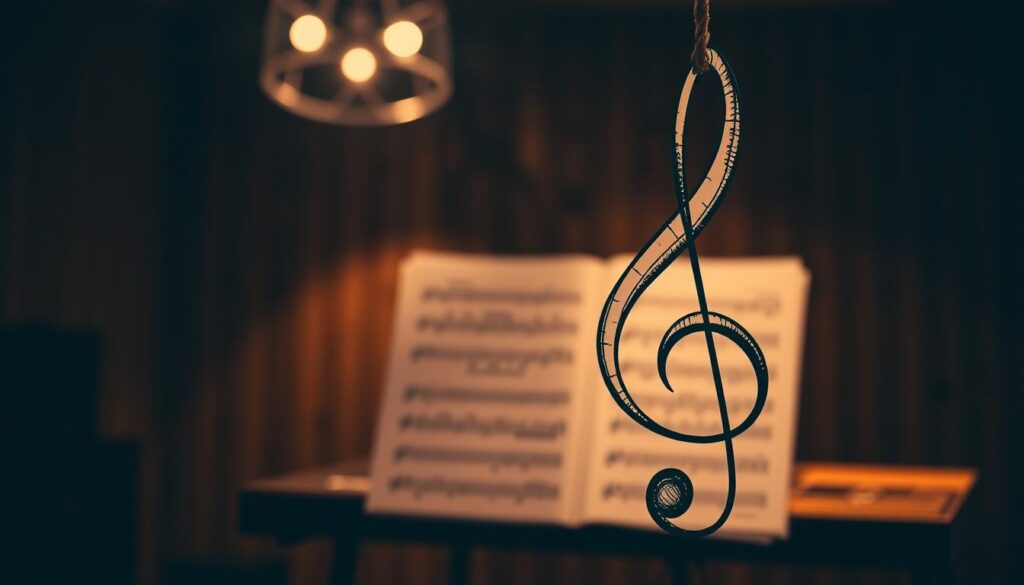
The staff is the base of musical notation. It has five horizontal lines and four spaces. The treble clef, or G clef, marks the start of the staff. It tells us the notes are in a higher pitch.
It’s really exciting to see how these lines shape music. Knowing the clef tells us the pitch range we’re about to play or sing.
Notes on the Treble Staff
To read the staff, we use simple tricks to remember the notes. The five lines from bottom to top are E, G, B, D, and F. We remember them with the phrase “Every Good Boy Does Fine.”
The four spaces between the lines are for the notes F, A, C, and E. Learning these sequences makes music theory easier for beginners.
Ledger Lines and Their Uses
At times, melodies need notes above or below the standard staff. We use ledger lines for this. These are short, horizontal lines through the note head.
These lines extend the staff, allowing for more expression in musical notation. Knowing the treble clef and ledger lines is crucial for musicians wanting to grow their skills.
The Importance of Treble Frequencies
The physics of sound shows that high-pitched sounds are key to a recording’s clarity. When we listen to music, we notice how vibrations mix to create the sound we love. Knowing this helps us make better choices when adjusting audio levels.
Understanding Frequency Range
Every sound has a sound frequency, showing how fast it vibrates. High notes have a higher frequency, and low notes vibrate slower.
Imagine the difference between a deep rumble and a sharp whistle. The treble range is at the top, starting above the piano’s middle. Knowing this helps us see how audio engineers craft a song’s final sound.
Treble’s Impact on Sound Clarity
Treble makes vocals and lead instruments sound clear and sharp. Without it, music can sound dull or far away, lacking the sparkle that grabs our attention.
“Music is the shorthand of emotion, and the clarity of high-frequency detail allows that emotion to reach the listener with precision.”
These frequencies work with our ears to bring a sense of presence and detail to music. By balancing sound frequency, producers make sure every instrument fits perfectly. A well-balanced high pitch range makes a song sound professional and vibrant.
Treble vs. Bass: A Comparison
Music is all about the mix of high-pitched Treble sounds and deep bass. These two parts are key to musical notation. They help composers write down complex sounds in a way we can read. Knowing how they work helps us appreciate the structure of a song more.
Key Differences Explained
The main difference is in the pitch range each clef covers. The Treble clef is for high-pitched instruments. On the other hand, the bass clef is for low-pitched ones. Instruments like the bassoon and cello use the bass clef to show their deep sounds.
In music theory, these clefs are like maps for musicians. The treble clef focuses on the melody and high notes. The bass clef gives the rhythm and harmony that holds the song together. This way, every instrument has its place on the staff.
| Feature | Treble Clef | Bass Clef |
|---|---|---|
| Primary Range | High Pitches | Low Pitches |
| Common Instruments | Violin, Flute, Piano (Right Hand) | Cello, Tuba, Bassoon |
| Musical Role | Melody and Harmony | Rhythmic Foundation |
How They Work Together in Music
A complete musical score combines these two systems. When we look at a grand staff, we see the Treble and bass clefs together. This harmonic balance is key for both playing and writing music.
Without the bass, the high notes would sound empty. Without the treble, the music would feel too heavy. Together, they create the foundation of Western musical notation. They guide us through the emotional journey of a song.
Enhancing Music With Treble
We can change how a song sounds by adjusting the high notes. By tweaking these high notes, we add sparkle and clarity to our favorite songs. This is key to making sure every instrument sounds right in the mix.
Increasing Treble in Audio Mixing
In the studio, we use equalization to boost the treble range. This makes cymbals sound crisp and vocals sound breathy. High-quality audio equipment lets us make these changes without distortion.
We use treble control to balance the brightness of a recording. If a mix sounds dull, a bit more high sound frequency can clear it up. Here are some tips for better results:
- Use a high-shelf filter to gently lift the upper frequencies.
- Apply subtle saturation to add harmonic richness to the high end.
- Check your mix on different speakers to ensure the balance remains consistent.
Effects of Treble in Genres
Different music styles use high notes in unique ways. In modern pop, producers boost treble for a polished sound. This makes vocals feel close and personal.
On the other hand, classical music focuses on natural sound. It uses treble control carefully to keep the warmth of acoustic instruments. Knowing these genre-specific needs helps us use our audio equipment to create the right mood in our music.
Common Misconceptions About Treble
Exploring high-fidelity audio means knowing what’s real and what’s not. Many think tweaking their treble control will change a singer’s voice pitch. But, this isn’t usually true. We need to grasp how these tweaks affect the sound frequency spectrum for a balanced sound.
Is Treble Always High-Pitched?
Many confuse treble with just a high pitch. But, treble is a wide range of frequencies that add clarity and detail to music. It’s not just a “brightness” control; it shapes the sound of instruments like cymbals or violins.
Adjusting our audio equipment often changes a broad range of frequencies, not just a single note’s pitch. For a deeper look, check out the research on new standards for in-ear target curves. Knowing this helps us tweak our systems better.
Can Too Much Treble Be Harmful?
Some fear too much treble could harm their hearing. While high frequencies are key for detail, too much can cause ear fatigue. This makes listening uncomfortable and can dull our musical sensitivity.
“The goal of high-fidelity reproduction is not to emphasize one frequency range over another, but to maintain the integrity of the original performance.”
We suggest keeping your treble control at neutral levels for your hearing. If you’re always boosting the high end, your audio equipment might be hiding details in the recording. Moderation is key for enjoying your music without harm.
| Myth | Fact | Impact |
|---|---|---|
| Treble is just high pitch | It is a frequency range | Affects clarity |
| More treble is better | Can cause ear fatigue | Reduces comfort |
| Settings change the note | Settings change the volume | Alters balance |
Famous Songs Featuring Strong Treble Elements
The treble range adds magic to melodies, from pop hits to orchestral classics. By exploring these iconic songs, we learn how high notes affect our emotions. These examples show how composers use treble to create shimmering sounds.
Pop Songs Showcasing Treble
Modern pop songs often use bright, high sounds to catch our attention. For example, Taylor Swift and The Weeknd’s songs start with catchy, high-pitched melodies. These melodies are meant to stand out, even on small speakers.
Listen closely to the lead vocals and synth leads in these songs. The brilliance of the sound comes from the upper frequencies. This makes the song’s character shine and keeps the energy up in the chorus.
Classical Pieces Emphasizing Treble
Classical music is full of beautiful high notes. Composers like Mozart and Vivaldi used the violin’s upper range to create joy and lightness. In these pieces, the treble is key, not just background.
Looking at the musical notation of a violin concerto shows the complexity of these high notes. The musicians must play intricate scales with great skill. This highlights how the treble range adds clarity, making the music feel transcendent.
Tips for Beginners to Master Treble in Music
Building a strong foundation in music theory takes effort and curiosity. We encourage you to use these techniques to improve your skills. This will help you appreciate the sounds you create more.
Building Proficiency Through Scales
Start by practicing the C major scale every day. This sequence of notes, C, D, E, F, G, A, B, C, is great for learning the treble clef. Regular practice helps your fingers learn the right keys and your eyes to spot notes on the staff.
Developing Your Musical Ear
Active listening is key to your growth. Try to pick out melodies or patterns in your favorite songs. This will help you understand treble frequencies better. Tools like the Yamaha digital piano or software like Ableton Live can help you focus on these sounds.
Mastering these skills takes time, but your hard work will pay off. Keep exploring your instrument to find new creative ways to play. We hope this guide helps you on your journey to becoming a more confident musician.