
 Zoe Nora
Did you know over 70% of home theater owners never tweak their audio settings? Most people stick with flat, thin sound, missing out on a cinematic experience from their couch.
Modern tech turns standard speakers into a deep, immersive field. It uses advanced processing for Virtual surround tech. This tech creates a sense of space that fills your room. Whether watching a blockbuster or playing a game, the right setup makes a huge difference.
You can upgrade your living room without buying extra speakers. This innovative Virtual surround sound approach brings professional quality home. If you want to stay updated, sign up for our newsletter for new hardware releases.
Key Takeaways
- Most home audio systems are underutilized due to default settings.
- Advanced processing creates an immersive field without extra hardware.
- Gaming performance improves with better spatial audio awareness.
- Upgrading your home setup is simpler than most users realize.
- Subscribing to our newsletter provides the latest industry trends.
What is Virtual Surround?
If you’ve ever felt like you’re inside a movie while sitting on your couch, you’ve experienced the power of modern audio engineering. Many listeners are surprised to learn that their compact equipment can produce a wide, cinematic soundstage. This is all done without needing speakers in every corner of the room.
This immersive audio technology tricks the human brain into perceiving depth and directionality. Advanced digital signal processing creates a rich soundscape. It feels much larger than the physical hardware suggests.
Definition and Overview
At its core, virtual surround is a sophisticated method of processing audio. It simulates a multi-speaker environment using fewer physical drivers. Instead of a traditional 5.1 or 7.1 setup, it uses software algorithms to manipulate sound waves.
These algorithms adjust the timing and volume of audio signals. They mimic how sound reaches our ears in the real world. This allows a single soundbar or a pair of headphones to provide a convincing sense of space and movement.
How It Works
The magic behind this experience relies on psychoacoustics. Specific filters are applied to make a sound appear to come from behind or above the listener. This is done even when the speaker is positioned directly in front.
This process often involves Head-Related Transfer Functions (HRTF). These mathematical models account for how our ears and head shape sound waves. When the audio is processed correctly, our brain interprets these cues as directional information.
Differences from Traditional Surround Sound
A surround sound system typically requires extensive wiring and multiple physical speakers. This is to achieve true spatial audio. In contrast, virtual solutions prioritize convenience and space efficiency.
These differences can sometimes lead to compatibility issues. For instance, a user might find that their vintage NES console sounds off on one virtual surround setup but performs perfectly on another. This usually happens because the processing software interprets older, stereo-based audio signals differently than modern, multi-channel formats.
| Feature | Traditional System | Virtual System |
|---|---|---|
| Speaker Count | Multiple (5+) | Minimal (1-2) |
| Installation | Complex Wiring | Plug and Play |
| Space Usage | High | Low |
Benefits of Virtual Surround for TV Watching
Getting a top-notch virtual sound experience at home changes how we watch movies. Standard TV speakers often can’t capture the full depth of a film. This leaves the sound feeling flat and not connected to the visuals.
Immersive Experiences in Movies
Today’s audio tech lets us mimic the sound of theaters at home. It uses smart algorithms to create a truly enveloping sound field. This pulls us into the story more deeply.
- Increased depth in background sound effects.
- Seamless transition of audio cues across the room.
- Consistent volume levels during intense action scenes.
Enhanced Dialogue Clarity
One big problem with watching movies at home is hearing what characters say. Our virtual systems isolate voices from background noise and music.
This makes dialogue crisp and clear, even in loud scenes. We don’t have to keep adjusting the volume to hear every word.
Sound Stage Expansion
A key goal of any virtual sound experience is to go beyond your TV. It makes it seem like sound is coming from places where no speakers are.
This creates a sense of space. It makes us feel like we’re right in the middle of the action. It’s a must-have for anyone wanting a theatrical atmosphere at home, without a big, complex setup.
Advantages of Virtual Surround for Gaming
Getting the virtual sound experience right is more than just having a top-notch monitor. It’s about understanding space through sound, which advanced audio makes possible. This tech turns digital worlds into real ones by making us feel sound’s depth and direction.
Increased Situational Awareness
In a game, knowing where enemies are is key. 3D audio simulation lets us hear the smallest sounds, like footsteps or gunfire far away. This means we can always stay one step ahead of our foes.
Competitive Edge in Multiplayer Games
For fast-paced multiplayer games, quick thinking is everything. Using virtual surround, we react faster to audio clues than others. This sharpens our focus in battles, helping us make smarter moves on the fly.
Enhancing Game Atmosphere
This tech also makes single-player games more engaging. It makes us feel closer to the game world, thanks to realistic sounds like wind or rain. This immersive quality turns games into movies.
| Game Genre | Audio Priority | Impact of Virtual Surround |
|---|---|---|
| First-Person Shooters | Directional Cues | High (Pinpoint accuracy) |
| Open World RPGs | Ambient Depth | High (Deep immersion) |
| Racing Simulators | Engine/Tire Feedback | Medium (Spatial awareness) |
| Strategy Games | General Soundscape | Low (Atmospheric focus) |
How to Set Up Virtual Surround at Home
Setting up a virtual audio environment at home is simpler than you might think. Just a few steps can turn your TV setup into a home theater. Look into the best home sound options to get the right hardware.
Compatible Devices and Software
First, check if your TV or soundbar supports virtual surround. Most smart TVs and soundbars have Dolby Atmos or DTS Virtual:X. Check your device’s manual or the manufacturer’s website to confirm.
Make sure your firmware is up to date. This can improve your audio processing. Also, set your streaming device’s audio output to “Auto” or “Bitstream” mode. This ensures the raw audio signal is passed to your sound system.
Optimizing Speaker Placement
Even with virtual surround, where you place your equipment matters. Sound waves need reflections from walls and ceiling to create space. Don’t put your soundbar in a closed cabinet, as it will muffle the sound.
Place your soundbar at ear level for the best sound. If you have a subwoofer, put it in a corner on the floor. This enhances the low-frequency response and creates a solid acoustic foundation.
Adjusting Settings for Best Results
After setting up your hardware, adjust your device’s audio settings. Most systems let you tweak “virtual height” or “width” settings. Adjust these while sitting in your main viewing spot for a balanced soundstage.
By fine-tuning these settings, you can tailor the sound to your unique seating position. If dialogue sounds thin, increase the center channel level. If background effects are too quiet, adjust the surround intensity until the audio feels immersive.
| Setup Step | Action Required | Goal |
|---|---|---|
| Hardware Check | Verify format support | Ensure compatibility |
| Firmware Update | Install latest software | Optimize processing |
| Placement | Clear obstructions | Improve acoustics |
| Calibration | Adjust room settings | Personalize audio |
Popular Virtual Surround Technologies Explained
For home theater fans, knowing about immersive sound standards is key. Modern audio has seen big changes thanks to surround sound systems. Now, we can get theater-quality sound at home without needing many speakers.
Dolby Atmos
Dolby Atmos is a big name in audio. It changed how we think about sound by focusing on object-based audio. Sounds are treated as objects moving in space, not just coming from speakers.
This tech uses 3D audio simulation to place sounds exactly where they should be. It makes sounds like rain or helicopters seem to come from above, adding depth to your listening experience.
DTS Virtual:X
DTS Virtual:X is all about being flexible and working with many devices. It’s designed to give you an immersive sound experience, no matter the source.
“The goal of virtual processing is to remove the physical barriers of a room, allowing the listener to be fully enveloped by the soundscape.”
It’s great at making standard sound systems sound like they have height and depth. This makes it a highly cost-effective solution for those who want to improve their sound without buying new speakers.
Sony’s Virtual Surround Solutions
Sony has made a name for itself by using its own spatial audio technology in its products. This tech is fine-tuned for Sony’s speakers and amplifiers, giving it a unique edge.
- Hardware Synergy: Tailored processing for specific speaker arrays.
- Dynamic Calibration: Real-time adjustments based on room acoustics.
- Seamless Integration: Works effortlessly with Sony TVs and gaming consoles.
These solutions ensure sounds are placed with perfect accuracy. Choosing a system that matches your gear gives you a competitive advantage in both movies and games.
Virtual Surround vs. Headphones
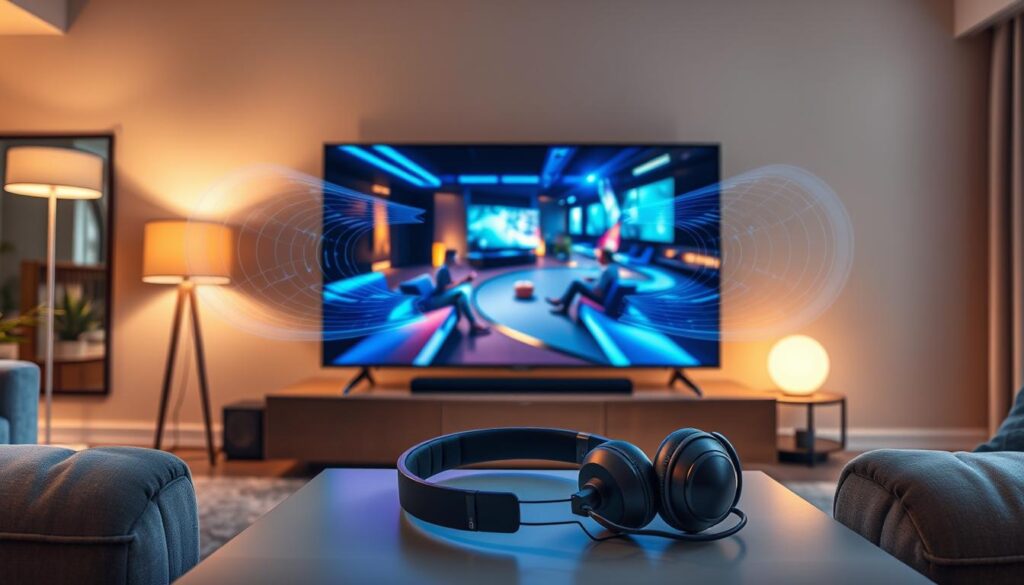
Headphones offer a personal sound experience that speakers can’t always match. They are perfect for enjoying virtual surround sound in a more intimate way. This is different from the room-filling sound of speakers in home theaters.
Benefits of Using Headphones
Using headphones lets you enjoy deeply immersive audio without disturbing others. They’re great for late-night gaming or movie nights when it’s quiet.
High-quality headsets also block out background noise. This lets you focus on the nuanced audio cues in your favorite shows and games.
Comparing Audio Quality
Headphones have a big advantage in audio quality. They offer precise virtual surround sound because the drivers are right over your ears.
Speakers, on the other hand, can be affected by room acoustics. This can lead to sound reflections or muddiness. Headphones give you a cleaner, more direct signal that keeps the sound mix pure.
Situational Uses
In small spaces like apartments, headphones are often better than full-room systems. They let you enjoy a cinematic experience without needing big equipment.
Gamers get a big benefit from high-end headsets. They can pinpoint sounds like footsteps or gunfire more easily. This is thanks to virtual surround sound technology.
Common Myths About Virtual Surround
If you’ve been hesitant to try new audio tech because of myths, it’s time to learn the truth. Many people think virtual surround sound is just a fancy trick. But it’s based on real science that makes your brain think you’re hearing sounds from all around.
Myth: It’s Just an Audio Trick
Some say virtual audio environment is just a digital trick. But it’s actually based on how our ears work. Engineers use special math to make sound seem like it’s coming from different places. It’s not just a trick; it’s real science that makes your music sound better.
Myth: Equipment Requirements Are Too High
Many think you need expensive gear to enjoy virtual surround sound. But, many mid-range devices can do a great job. If you want to improve your gaming audio, you might be surprised at how well standard sound cards work.
Myth: Sound Quality Is Compromised
Some worry that virtual surround sound will make their music sound worse. But, today’s tech keeps the sound clear and full. When set up right, it can make your music sound as good as having many speakers.
| Common Myth | The Reality | Impact on User |
|---|---|---|
| It is just a gimmick | Based on psychoacoustics | High immersion |
| Requires expensive gear | Works on mid-range hardware | Cost-effective |
| Lowers audio quality | Maintains high fidelity | Clearer sound |
Virtual Surround in the Streaming Era
Our way of enjoying sound at home is changing fast. Streaming services are now our main source for entertainment. It’s important to make sure our sound systems can keep up with the latest content.
Integration with Streaming Platforms
Big names like Netflix, Disney+, and Apple TV+ are adding spatial audio technology to their shows. They use special codes that let sound systems place sounds just right in your room.
“The future of home entertainment relies on the seamless marriage of high-definition visuals and immersive, multidimensional soundscapes.”
Thanks to these new codes, streaming services can create a virtual audio environment that feels like a real cinema. Even with just a few speakers, you can enjoy a deep, detailed sound.
Best Practices for Streaming Sound Settings
To get the best sound, set your streaming device to “Auto” or “Pass-through” mode. This lets the raw audio signal go straight to your soundbar or receiver without being changed too much.
- Always check for firmware updates on your streaming hardware.
- Ensure your HDMI connection supports eARC for high-bandwidth audio.
- Disable any “Night Mode” or “Dynamic Range Compression” settings if you want the full, uncompressed experience.
Recommendations for Streaming Devices
Not all devices handle high-bitrate audio the same. For top-notch sound, use a dedicated streaming box like the Apple TV 4K or the NVIDIA Shield TV Pro. They’re built to handle complex virtual audio environment data quickly.
These devices have the power to decode high-fidelity streams well. By picking the right hardware, your spatial audio technology will stay sharp, clear, and in perfect sync with your screen.
Future of Virtual Surround Technology
The world of audio is changing fast. We’re moving from fixed setups to systems that adjust to your room’s sound. This change in immersive audio technology means everyone gets a top-notch sound experience, no matter where they sit.
Trends in Audio Technology
AI-driven room calibration is a big deal now. Modern tech scans your space to adjust sound on the fly. This cuts down on distortion and makes sound clearer.
These new features make high-quality sound easy to get without complicated setups. If you want to upgrade, check out modern surround sound options. Soon, even basic devices will have these smart features.
Potential Innovations
We’re expecting huge steps in 3D audio simulation. New tech will track your head movements for a more realistic sound experience. It’s like hearing sounds in real life.
Spacial audio technology is getting better too. It lets sounds move freely around you, not just from speakers. Look out for:
- Dynamic beamforming that targets your ears.
- Smarter sound processing for smaller devices.
- Cloud updates that boost your audio over time.
Role in Smart Home Integration
Home entertainment is becoming one big, connected system. Your audio will talk to other smart devices to make your space perfect for watching movies. For example, lights might dim and curtains close when you start a film.
This integration means your home theater is always set for an amazing experience. It makes top-notch sound easy for everyone. We think this will be a big part of the next decade of home entertainment.
Comparison: Virtual Surround and Traditional Systems
The debate between virtual audio and a traditional surround sound system focuses on three key points. Your budget, the size of your living area, and the time you’re willing to spend setting it up are crucial.
Cost Effectiveness
Virtual solutions are often more affordable. They don’t require buying multiple speakers, expensive receivers, or costly wiring to get that cinematic feel.
On the other hand, a traditional surround sound system needs a bigger investment. It includes several components. While these systems deliver unmatched power, the total cost can be high.
Space Considerations
For those living in small spaces, virtual systems are perfect. They work well in apartments or small rooms where setting up rear speakers is impractical.
Traditional setups, though, need a lot of space for speakers and mounts. If your room is small, a virtual system lets you enjoy immersive audio without cluttering your space.
Installation Complexity
Installation complexity is a big factor for many. Virtual solutions are easy to set up, often needing just one HDMI cable.
In contrast, traditional surround sound systems are more complex. They require calibration, precise speaker placement, and cable management. For those who want a plug-and-play experience, virtual tech is a better choice.
| Feature | Virtual Surround | Traditional System |
|---|---|---|
| Initial Cost | Budget-Friendly | High Investment |
| Space Needed | Minimal | Extensive |
| Setup Time | Very Fast | Time-Consuming |
| Audio Precision | Simulated | Discrete/Physical |
User Reviews and Experiences
Real-world feedback gives us the truth about virtual sound experience in our daily lives. By looking at what actual owners say, we learn how these systems work in different homes.
What Gamers Are Saying
Gamers say these systems give them a significant competitive edge. They can hear enemy footsteps or distant gunfire better than with regular speakers.
- Enhanced spatial awareness during multiplayer matches.
- Improved immersion in open-world exploration games.
- Reduced listener fatigue during long gaming sessions.
Movie Buff Perspectives
Film lovers say switching to a virtual sound experience changed everything. They no longer need complex setups to feel like they’re in a movie theater at home.
“I was skeptical that a single bar could replicate a theater, but the depth of the soundstage completely changed how I watch my favorite action movies.”
Common Feedback Across Platforms
Looking at online forums, we see a common theme. Most agree the virtual sound experience works well in most rooms. But, it needs the right setup for the best sound.
Feedback includes:
- Ease of installation is a major win for apartment dwellers.
- Room acoustics play a vital role in how well the sound reflects.
- Some users note that extreme volume levels can occasionally lead to minor distortion.
Overall, most people are happy with the mix of convenience and performance. They’re satisfied when they adjust their settings for their home.
Tips for Choosing the Right Virtual Surround System
Starting your home entertainment upgrade begins with picking the right audio gear. First, think about your room size and how you use it. A small apartment might do well with a soundbar, while a big media room needs a full surround sound system.
Key Decision Factors
Your budget is a big factor in your choice. High-end brands like Sonos or Bose offer top-notch sound for those willing to spend more. Sony is great for gamers who want accurate sound placement. Also, think about the space for cables and speakers.
Optimizing Your Environment
Small tweaks to your room can make a big difference. Use soft furniture and rugs to cut down on echoes. Place your main listening spot in the center for the best sound. Try out these changes to enhance your audio experience at home.