
 Zoe Nora
Did you know that while the human ear can theoretically detect sounds from 20Hz to 20kHz, most adults lose the ability to hear anything above 15kHz by their early twenties? This biological limitation makes it even more critical to ensure your audio gear reproduces the remaining spectrum with absolute precision.
We believe that mastering the concept of frequency response is the single most important step for any serious listener. It serves as the technical foundation for evaluating how speakers, headphones, and amplifiers handle sound across the audible range. Without this knowledge, you are basically guessing when you upgrade your home setup.
By understanding how your equipment colors or flattens the audio signal, you gain the power to curate a listening experience that truly honors the artist’s intent. Let us explore how this essential metric defines the clarity and balance of your favorite tracks.
Key Takeaways
- The human hearing range naturally narrows as we age.
- Understanding audio output helps you identify high-quality gear.
- A flat curve is often the gold standard for accurate sound reproduction.
- Equipment choices directly impact how you perceive bass, mids, and highs.
- Mastering these basics prevents costly mistakes during future upgrades.
What is Frequency Response?
Every audio device has its own sound signature. This is how it plays sound across different frequencies. Looking at a speaker or headphone’s specs is like checking its sound translation skills. Knowing about frequency response is key to enjoying clear sound at home or in the studio.
Definition and Importance
The frequency response definition shows a device’s ability to play sound evenly. It tells us how much it changes the sound, adding bass or highlighting high notes. This is crucial because it affects the accuracy and character of what you hear.
If a device doesn’t balance its output, your music might sound unclear or too sharp. Paying attention to this helps your audio sound as close to the original as possible.
Measuring Frequency Response
Engineers test this by sending a range of tones through a device and recording it. They use special tools to see how it handles bass and high notes. This data is then graphed to show where the device might do well or struggle.
Common Terms Explained
In technical manuals, you’ll find specific terms about audio frequency response. Knowing these terms helps you understand what manufacturers mean.
| Term | Description | Sound Impact |
|---|---|---|
| Flat | Equal output across all frequencies | Neutral and accurate |
| Boosted | Increased volume in a specific range | More punch or brightness |
| Rolled-off | Decreased volume at the extremes | Softer, less harsh sound |
| Dip | A sudden drop in a specific frequency | Hollow or missing detail |
Understanding these concepts lets you pick gear that fits your listening style. Whether you prefer a flat sound for mixing or a warm, bass-heavy sound for relaxing, the frequency response is your guide.
The Audio Spectrum and Its Characteristics
Understanding sound waves is key to grasping audio frequency response. Sound is made of mechanical vibrations in air. These vibrations cause pressure changes our ears turn into sound.
Understanding Sound Waves
Sound waves have a frequency measured in Hertz (Hz). A higher frequency means a higher pitch, and a lower frequency means a deeper tone. When we talk about frequency response definition, we’re looking at how devices reproduce these waves.
Frequency Range of Human Hearing
Healthy adults can hear sounds from 20 Hz to 20,000 Hz. But, we’re not equally sensitive across this range. We’re most sensitive around 3.5 kHz, thanks to our ear’s natural resonance.
Standards like ISO 226:2023 guide us on how our brains perceive volume at different frequencies. This helps engineers fine-tune equipment to match our hearing.
Audio Bands: Bass, Midrange, Treble
We divide the audio spectrum into three main bands. Each band has its own role in how we experience music and speech. Understanding these bands is crucial for improving your audio frequency response knowledge.
| Audio Band | Frequency Range | Primary Characteristics |
|---|---|---|
| Bass | 20 Hz – 250 Hz | Provides weight, rhythm, and physical impact. |
| Midrange | 250 Hz – 4 kHz | Contains the core of human vocals and instruments. |
| Treble | 4 kHz – 20 kHz | Adds clarity, detail, and spatial airiness. |
The midrange is crucial because it’s where we’re most sensitive. Making sure your equipment handles this range well is essential for a natural sound. By balancing these bands, you can get a high-quality listening experience that respects the frequency response definition in every detail.
How is Frequency Response Measured?
We use special methods to figure out how audio gear handles sound. By doing a frequency response measurement, we see how it changes the sound. This is key for those who want their sound systems to be just right.
Equipment Used for Measurement
To do a frequency response analysis right, we need more than just our ears. We use a calibrated microphone, a top-notch audio interface, and software like REW (Room EQ Wizard).
- Measurement Microphone: A flat-response omnidirectional mic is key for unbiased sound capture.
- Audio Interface: It turns analog signals into digital data for processing.
- Analysis Software: Programs like REW create test tones to show the spectrum.
Methods of Testing Frequency Response
The main method is playing a frequency sweep through the device and recording it. Then, we compare it to the original signal to find any changes. We use weighting filters to make these results standard.
“A-weighting curves are based on how our ears hear sound at lower volumes. They help match technical measurements to real-world hearing.”
This audio frequency response standard makes it easier to compare different gear. Without these filters, the data wouldn’t match what we hear in real life.
Interpreting Frequency Response Graphs
After collecting the data, we use a frequency response curve to see it. This graph shows where the equipment does well or struggles. A flat line is ideal, but many devices have curves for specific tastes.
| Feature | Ideal State | Common Issue |
|---|---|---|
| Bass Response | Extended and tight | Muddy or bloated |
| Midrange | Clear and neutral | Recessed or harsh |
| Treble | Detailed and smooth | Sibilant or rolled-off |
When you look at your frequency response curve, watch for sharp peaks or deep valleys. These often show room problems or hardware limits. Understanding this frequency response analysis helps us improve our audio setups for better sound.
The Impact of Frequency Response on Sound Quality
Frequency response is key in how speakers and headphones turn electrical signals into sound. It sets the sonic signature of our devices, showing what parts of sound are highlighted or hidden. By studying the frequency response analysis, we learn why some sound warm, bright, or neutral.
Frequency Response in Speakers
Speakers face a challenge to keep sound even across all audible frequencies. Big speakers are great at deep bass, while smaller ones might lack in low sounds. The design and build of the speaker greatly affect what we hear.
- Driver size: Bigger woofers handle low sounds better.
- Crossover points: These help different drivers work together for a unified sound.
- Room interaction: The room can change how we hear sound more than the speaker itself.
Frequency Response in Headphones
Headphones face a unique challenge because they don’t interact with the room. Engineers use the Harman target curve to make sound natural. This includes a boost at 3.5 kHz to match how our ears naturally hear.
Without this boost, music might sound dull or “inside the head.” The carefully calibrated frequency response makes sound balanced and enjoyable for long listening. It helps bridge the gap between studio recordings and how we naturally hear.
Real-World Applications in Music Production
For music producers, knowing their monitoring system’s frequency response is crucial. If monitors have too much bass, producers might cut too much low-end. This can make mixes sound thin on other systems.
We need consistent audio frequency response for our creative choices to work across different platforms. Using calibrated monitors and headphones helps us make accurate adjustments. This way, we can achieve professional-grade clarity in every project.
The Role of Equalization in Frequency Response
Equalization connects the raw sound from your gear to what you like to hear. It changes the frequency response of an audio signal. This way, we can make the sound fit our room or personal taste better.
What is Equalization?
Equalization is about adjusting the sound balance in an electronic signal. It lets us boost or lower certain sound frequencies. This helps create a sound that’s more balanced or pleasing to our ears.
The goal of equalization is to make the music sound as natural and engaging as possible within the constraints of your listening environment.
Adjusting Frequency Response with EQ
We use equalization to improve our listening experience. But, we should not rely on it too much. It’s great for fixing small sound issues, but it can’t fix big problems with the equipment.
Using EQ well means making small changes. This way, we can adjust for room sounds or our own hearing without harming the original sound.
Different Types of Equalizers
There are many ways to adjust sound, with graphic and parametric equalizers being the most common. Graphic equalizers have fixed bands for quick changes. Parametric equalizers offer more control, letting you fine-tune every detail.
| EQ Type | Control Level | Best Use Case |
|---|---|---|
| Graphic | Fixed Bands | Quick room correction |
| Parametric | High Precision | Surgical frequency shaping |
| Shelving | Broad Adjustment | General tone balancing |
Knowing how these tools affect your frequency response is key for any serious listener. Whether you use software or hardware, the right equalization makes listening to high-quality audio more enjoyable.
Factors Affecting Frequency Response Performance
Your listening space is a key part of your audio setup. We often look at the tech specs of our gear. But, the place where we listen can change how sound sounds.
Even the best equipment can struggle if the room isn’t right. The right environment is crucial for good sound.
Room Acoustics
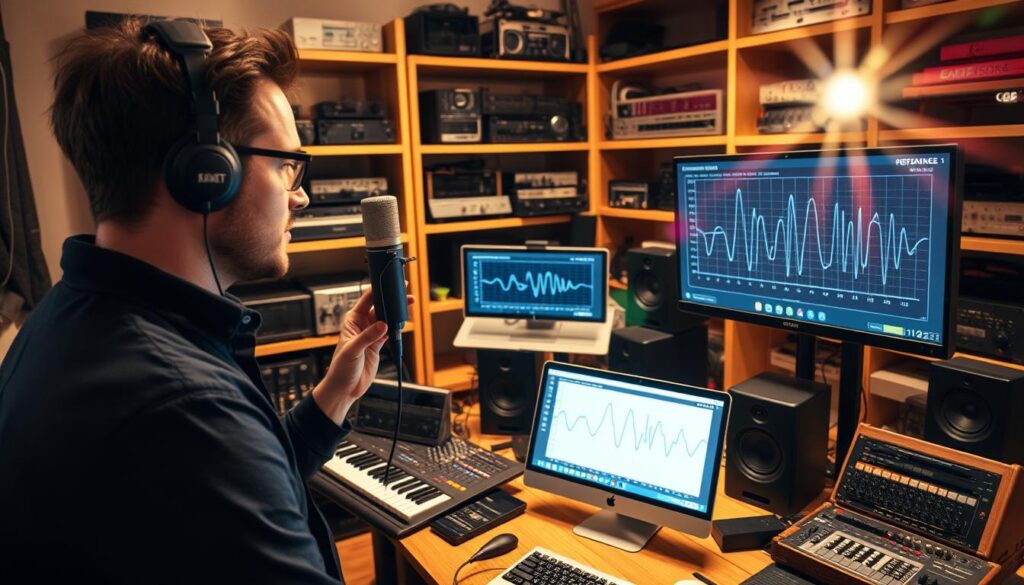
The room’s shape, size, and materials affect sound. Hard surfaces like glass and concrete bounce sound, causing echoes. This messes up the clarity of the audio.
On the other hand, soft materials like carpets and curtains soak up high frequencies. This can make the sound dull or muffled.
Standing waves are a problem in small rooms. These happen when sound waves bounce off walls, creating uneven bass. Doing a frequency response analysis can help find these issues. Then, you can use acoustic panels or bass traps to fix the sound.
Speaker Placement and Setup
Where you put your speakers is as important as the speakers themselves. Placing them too close to corners can make the bass too loud. For better sound, think about getting floor-standing speakers that work well with your room.
Here are some basic tips for setting up your speakers:
- Keep speakers in an equilateral triangle with your listening spot.
- Stay away from side walls to avoid early reflections.
- Use stands to keep speakers off surfaces and reduce vibrations.
Equipment Quality
The room is important, but so is the quality of your signal chain. Bad cables or weak amplifiers can distort the sound. Make sure your amp matches your speakers’ impedance to keep the signal clear.
| Component | Impact on Sound | Optimization Tip |
|---|---|---|
| Amplifier | Power delivery | Match impedance |
| Cables | Signal integrity | Use shielded wires |
| Room | Acoustic balance | Add sound treatment |
By focusing on room, equipment, and setup, you can improve your sound without buying new gear. Small changes in your room can make a big difference.
Different Formats and Their Frequency Response
Exploring audio formats shows us that not all recordings are the same. The way audio is captured and stored affects how we hear it. Whether you love the sound of old media or the clarity of new files, knowing these differences is crucial for great sound.
Digital vs. Analog
Analog formats, like vinyl and magnetic tape, add unique sounds to music. These mediums can’t always keep the sound perfect at the highest and lowest frequencies. Yet, many fans enjoy the special warmth and distortion that analog brings.
Digital audio, on the other hand, is very precise. It captures a wide range of sounds with little error. For more on this, check out this guide on frequency response explained to see how digital stacks up against traditional methods.
Variations in Audio File Formats
Choosing the right file format is key to keeping the audio sound true. Lossless formats like FLAC or WAV keep all the original data, ensuring the sound stays just as it was meant to be. These are perfect for those who want the clearest sound possible.
Lossy formats, such as MP3 or AAC, are smaller but might lose some of the high sounds. This can change the music’s balance. While they’re great for listening on the go, they might not offer the same richness as lossless files.
The Influence of Streaming Services
Streaming services have changed how we listen to music. But, they also affect the sound quality. Most services compress the audio to save bandwidth, which can alter the sound. Make sure to check your app settings to stream at the highest quality possible.
- High-Resolution Streaming: Offers the best fidelity by minimizing compression artifacts.
- Standard Streaming: Convenient but may sacrifice high-end clarity.
- Offline Downloads: Allows for consistent quality regardless of internet stability.
How to Choose Audio Equipment Based on Frequency Response
Building a high-fidelity system is all about finding the right balance. It’s important to understand frequency response data to make smart choices. This means looking beyond just the numbers.
Key Specifications to Look For
Don’t just look at the range numbers. A claim like “20Hz to 20kHz” is not enough. You need to know the tolerance, like +/- 3dB. This crucial detail shows how much volume changes across the spectrum.
Always choose products with a clear frequency response measurement graph. These charts show peaks and dips that numbers can’t. A flat line means a more accurate sound.
Matching Equipment for Optimal Performance
Creating a cohesive audio chain is key. Your amplifier and speakers should work together, not against each other. If your speakers are bright, a neutral amplifier keeps the sound balanced.
Look at impedance, sensitivity, and frequency response when choosing. Matching components ensures a clean, detailed sound. This harmony is what makes professional-grade audio possible at home.
Listening Tests: What to Consider
While data is important, your ears are the ultimate judge. Do personal listening tests with music you love. This lets you see how the equipment handles complex sounds and textures.
Notice how the sound feels over time. If it becomes fatiguing or harsh, it’s not right for you. The best equipment makes your favorite music sound just right.
Common Myths About Frequency Response
Exploring high-fidelity audio means sorting out marketing myths from real science. Many think a frequency response number tells everything about sound quality. But, the truth is much more detailed than a simple number.
Debunking Misconceptions
One big myth is that a wider frequency range means better sound. A speaker that covers 20Hz to 20kHz might look good on paper. But, it doesn’t mean those frequencies sound balanced or accurate. Subjective listening is the true test, not just numbers.
Understanding Manufacturer Specifications
Manufacturers often share data from ideal lab settings, not real life. A frequency response curve might look perfect in a lab. But, your living room adds reflections and standing waves. Remember, these specs are often smoothed to look better than they are.
It’s smart to look closely at how these measurements are shown. This helps avoid being fooled by marketing. The table below shows how specs are presented versus what’s real.
| Specification Type | Marketing Claim | Real-World Reality |
|---|---|---|
| Frequency Range | Broadest possible range | Usable output at volume |
| Tolerance | Perfectly flat line | +/- 3dB variance is standard |
| Testing Method | Anechoic chamber data | Room-dependent performance |
| Subjective Feel | Scientifically superior | Personal preference matters |
The “Flat” Frequency Response Debate
The debate over a perfectly flat frequency response is fierce. While a flat response is great for studio monitors, it’s not always best for casual listening. Many prefer a bit more bass or treble to match human hearing.
Seeing a frequency response curve as a tool for understanding a speaker is key. Trust your ears more than a perfect graph. Balance and clarity are often more important than a mathematically perfect line.
Conclusion: Embracing Frequency Response for Better Audio
To get high-quality sound, you need to understand how your gear works with your ears. We’ve looked at the basics that show how audio equipment plays sound.
Summary of Essential Concepts
Knowing about frequency response helps you see what’s good and bad about your audio setup. You can now check how different parts change your music. This knowledge makes listening to music more meaningful.
Start Your Personal Audio Journey
Try testing your speakers or headphones with different songs. Changing your settings to fit your room’s sound can open up new details. Look into brands like Sennheiser, KEF, and Audio-Technica for options that match your taste.
Resources for Continued Growth
For more learning, check out Sound on Sound or the Audio Engineering Society. These places have technical papers and forums to help you get better. By using these tips, you’ll hear every note just as the artist meant it.