
 Zoe Nora
Did you know that nearly 40% of all data errors in modern digital infrastructure stem from avoidable interference? This is why we must focus on the signal-to-noise ratio in our daily work. When background noise overpowers our data, it can ruin entire projects.
Keeping our signal clarity high is key for accurate analysis and reliable systems. Without a clear path for information, our work can be full of errors. We need strong strategies to block out unwanted noise.
In this guide, we’ll show how to improve our technical environments for better performance. By focusing on signal clarity, we can reduce external interference and keep our work safe. Learning to control the signal-to-noise ratio helps us achieve the precision needed for success.
Key Takeaways
- Understanding the impact of interference on data accuracy.
- Defining the core principles of system reliability.
- Identifying common sources of technical noise.
- Implementing professional strategies to enhance output quality.
- Ensuring consistent performance through proactive monitoring.
Understanding Signal-to-Noise Ratio
Understanding the math between signal and noise is key in audio engineering. It helps us know when our systems are working well or not. This is because of unwanted interference.
What is Signal-to-Noise Ratio?
The signal-to-noise ratio is simple. It’s the signal value divided by the noise’s standard deviation. This number tells us how clear our signal is compared to background noise.
A higher ratio means a cleaner sound. A low ratio means noise is affecting our sound quality. Keeping this balance is essential for professionals.
Importance in Various Applications
In audio quality, this ratio is a key to success. It helps professionals ensure every part of the signal chain is clear. Without it, fixing problems is hard.
In studios or big telecommunications, the signal-to-noise ratio is crucial. It lets us compare things fairly. By focusing on this, we improve our work’s fidelity and meet top audio engineering standards.
Factors Affecting Signal-to-Noise Ratio
To get the best out of our hardware, we need to understand what affects signal quality. We look at how different things inside and outside our systems impact the signal-to-noise ratio. By knowing these factors, we can better reduce noise.
Environmental Influences
Things outside our systems can mess with our data. Changes in temperature, electromagnetic fields, and vibrations can harm our electronics. We must deal with these factors to keep our systems stable.
System Design Considerations
How we design our systems is key to keeping signals clear. We face two types of noise: fixed-pattern and random. A good system design helps us reduce noise during fast processing.
When designing circuits, we aim to reduce crosstalk and signal loss. Knowing how these factors interact helps us improve our signal-to-noise ratio. Good planning keeps our hardware performing well.
Component Quality
The quality of our parts is crucial for signal processing. Using top-notch sensors and amplifiers helps keep a high signal-to-noise ratio. Choosing the best components lowers the chance of internal noise.
We check our hardware to make sure every connection is up to par. By focusing on precision engineering, we get a consistent signal-to-noise ratio everywhere. Our dedication to quality is the key to our noise reduction success.
Measuring Signal-to-Noise Ratio
Improving our systems starts with measuring signal quality. We need a clear baseline to spot where interference hurts our data. Measuring SNR is key to making our systems better.
Tools and Techniques
We use special tools to get accurate data. For digital imaging, we calculate the signal-to-noise ratio by dividing the mean gray value by the standard deviation. This gives us a good idea of how well our systems are doing.
We also use digital oscilloscopes and spectrum analyzers. These tools help us see the frequency domain and find unwanted noise. Using them regularly keeps our data consistent across different setups.
| Tool Type | Primary Function | Best Use Case |
|---|---|---|
| Digital Oscilloscope | Time-domain analysis | Real-time signal monitoring |
| Spectrum Analyzer | Frequency-domain analysis | Identifying noise sources |
| Statistical Software | Data calculation | Image and sensor processing |
Interpreting Measurement Results
After collecting data, we carefully analyze it. We check the signal-to-noise ratio to see if it meets our quality standards. If it’s too low, we need to make changes right away.
Understanding these results helps us choose whether to tweak our hardware or software. By focusing on measuring SNR, we keep our systems strong and reliable. This careful analysis is crucial for our long-term success.
Strategies for Improvement
Improving our systems starts with understanding how to improve signal quality and reduce noise. We aim for a balance that strengthens the desired signal and weakens unwanted interference. By using optimization techniques, we can increase the signal-to-noise ratio to professional levels.
Enhancing Signal Quality
To improve the primary signal, we often increase data collection time. This is because shot noise is directly related to the square root of the total signal count. By collecting more data points, we enhance the signal clarity.
We also ensure our hardware is set up for maximum efficiency. For those in small spaces, 8 home audio setup tweaks can greatly improve voice clarity. These tweaks help keep the signal clean as it travels.
“The quality of the output is only as good as the integrity of the input signal we preserve throughout the chain.”
Reducing Noise Sources
Minimizing the noise floor is crucial, just like boosting the signal. We focus on reducing external interference, like electromagnetic radiation or thermal noise. By isolating sensitive components, we prevent unwanted artifacts.
Here are steps to reduce noise effectively:
- Shielding: Use high-quality cables to block external interference.
- Grounding: Ensure all equipment shares a common, clean ground point.
- Isolation: Keep power lines separate from sensitive signal cables to avoid crosstalk.
By tackling these noise sources, we keep the signal-to-noise ratio high for quality performance. These optimization techniques help our output stay crisp and accurate. Paying close attention to these details is key for a professional setup focused on signal clarity.
Role of Filters in Signal Improvement
To get a better signal-to-noise ratio, we use filters smartly. These filters pick the good signals and block the bad ones. This makes our data cleaner and more reliable.
Types of Filters
We have many tools to fight interference. Simple median filters help by getting rid of sudden noise without messing up the data.
For tougher cases, we use non-local mean algorithms. These tools look at the whole dataset to find patterns. This really helps improve the signal-to-noise ratio in noisy places.
Implementing Filters in Our Systems
It’s key to set up filters right to keep important details and reduce background noise. We adjust our systems to keep the signal clear while cutting down on noise.
By choosing the right filters for our data, we keep the signal-to-noise ratio steady. This lets us find important information even when the data is bad.
| Filter Type | Primary Function | Best Use Case | Impact on Signal-to-noise ratio |
|---|---|---|---|
| Median Filter | Impulse noise removal | Real-time data streams | Moderate improvement |
| Gaussian Filter | High-frequency smoothing | General signal cleanup | Baseline improvement |
| Non-local Mean | Pattern-based denoising | Complex, high-noise data | Significant improvement |
Using Amplifiers Effectively
Managing gain well is key in audio engineering. Many think that turning up the volume improves the signal-to-noise ratio. But, increasing gain also boosts the noise, keeping the ratio the same.

Choosing the Right Amplifiers
Choosing the right gear is crucial for a clean signal. We look for units with a low noise floor and high dynamic range. This keeps our audio clear. We also check the impedance to avoid signal loss.
Good amplifiers cut down on internal noise. By picking equipment with strong shielding and top-notch circuitry, we avoid unwanted sounds. This careful choice is key for professional audio work.
Optimal Gain Settings
Finding the right gain levels is a fine balance. We want to boost the signal without causing distortion. Too much gain can clip the signal, lowering quality.
We follow a gain staging process to keep the signal-to-noise ratio good. Monitoring levels at each step ensures a strong signal and low noise. Here’s how different amplifiers perform under different loads.
| Amplifier Type | Noise Floor | Gain Efficiency | Best Use Case |
|---|---|---|---|
| Class A | Very Low | Moderate | High-Fidelity Audio |
| Class AB | Low | High | General Studio Use |
| Class D | Moderate | Very High | Portable Systems |
Importance of Shielding and Grounding
A high signal-to-noise ratio depends on isolating components from the outside. External electromagnetic interference is a big threat to clear data transmissions. Physical defenses help our systems work with precision and reliability.
Shielding Techniques
We use high-quality shielding to block unwanted radiation. Shielded cables are key, acting as barriers against environmental noise. They keep external signals from mixing with our data, keeping the signal-to-noise ratio high.
We also use metallic enclosures for a Faraday cage effect. This is crucial in areas with lots of radio frequency interference. Conductive materials around our hardware divert harmful energy, protecting our signals.
Grounding Best Practices
Good grounding is key for a stable electronic system. We follow strict rules to avoid ground loops, which can cause audible hum or digital jitter. A strong, low-impedance connection to earth ensures all parts share a common reference.
We focus on a star-grounding setup to keep our signal-to-noise ratio steady. This method stops stray currents from affecting our signals. Keeping these standards is essential for high-performance systems.
Digital Signal Processing (DSP)
We use Digital Signal Processing for tough data transmission tasks. It moves the focus from hardware to software, giving us better control over our data. This helps keep our information clear, even in noisy places.
Benefits of DSP in Enhancing SNR
DSP is great for real-time noise reduction without changing the system. It lets us pick out important signals from background noise with great accuracy. This boosts the signal-to-noise ratio, making our output clear and dependable.
Also, DSP is flexible for big data transmission networks. As our systems grow, we can update our algorithms to tackle new interference. This keeps our systems running well in fast-paced environments.
“Digital signal processing is the bridge between raw, noisy data and actionable intelligence in the modern era of communication.”
DSP Techniques We Can Utilize
We use advanced methods to get useful data from noisy data. Machine learning is a key tool, as it’s good at ignoring random noise. We train models to spot valid signals and ignore unwanted noise.
We also use image or data stream segmentation based on average gray levels. This method helps filter out background noise. Below is a comparison of these methods with traditional hardware-based filtering.
| Feature | Traditional Filtering | DSP-Based Methods |
|---|---|---|
| Flexibility | Low (Fixed hardware) | High (Software updates) |
| Noise Reduction | Limited | Advanced (ML-driven) |
| Data Transmission | Standard | Optimized |
| Signal-to-noise ratio | Baseline | Significantly Enhanced |
By using these sophisticated methods, our systems stay strong. We keep improving our noise reduction to meet industry needs. These tools help us get a better signal-to-noise ratio everywhere.
Leveraging Technology for Improvement
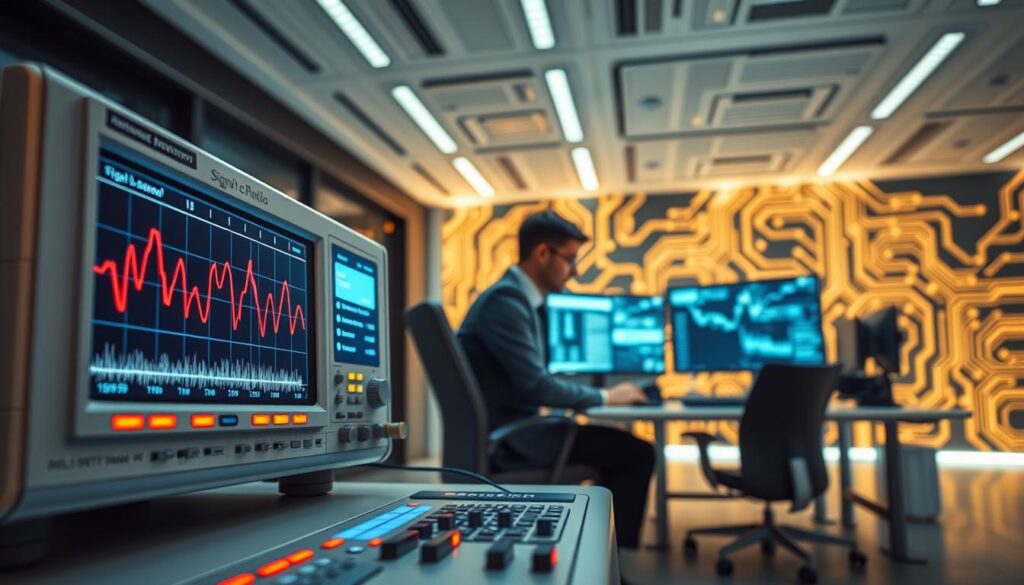
Modern innovation lets us explore new limits in signal processing. By using modern optimization techniques, we get more precision than before. This is thanks to newer hardware.
We always look for new tech to better our daily work. This keeps our systems up-to-date and ready for complex data.
Advanced Technologies
Switching to high-performance hardware has changed our infrastructure management. We use next-generation components for better stability and less interference.
These updates help improve our signal-to-noise ratio network-wide. Upgrading our setup reduces physical limits that block signal clarity.
Emerging Tools and Software
We also count on advanced software to improve our data. These optimization techniques let us make quick changes that were hard to do by hand.
Our team uses automated tools to keep a high signal-to-noise ratio during busy times. This software keeps signal clarity steady, even when things change outside.
Keeping up with new tech is key for us to grow. We’re committed to improving our signal-to-noise ratio with cutting-edge software and optimization techniques. This ensures lasting signal clarity.
Case Studies: Successful Implementations
Real-world examples show the real value of improving signal integrity in complex systems. By studying how top companies handle interference, we learn valuable lessons for our projects. These examples show how a better signal-to-noise ratio is key to reliable performance.
Examples from Telecommunications
Companies like Verizon and AT&T have made big strides in reducing noise in data transmission. They’ve upgraded their systems to use the latest communication technologies. This has greatly reduced packet loss rates.
When engineers focus on clear signals, networks become much more stable. This leads to better use of bandwidth. Users then see fewer drops and faster speeds, even when many are online at the same time.
Applications in Audio Systems
Professional recording studios show how crucial a clean signal path is for top-notch audio quality. They use balanced cabling and high-end preamplifiers to keep the sound clean from interference. This careful work ensures every detail of a performance is captured without unwanted noise.
The table below shows the typical improvements seen when these techniques are applied in different fields.
| Application Field | Primary Challenge | Optimization Result |
|---|---|---|
| Telecommunications | High packet loss | Improved data transmission |
| Audio Engineering | Background noise | Enhanced audio quality |
| Network Infrastructure | Signal interference | Stable communication technologies |
These examples prove that a high signal-to-noise ratio is not just a goal but a must. By using these strategies, we can keep our systems strong and efficient. We urge our teams to apply these lessons to achieve top-quality results in every project.
Regular Maintenance and Monitoring
Keeping our systems running smoothly is a top priority. Even the best equipment can slow down over time. We stick to a strict schedule to keep our signal-to-noise ratio at its best.
Importance of System Maintenance
Regular checks protect us from sudden failures and signal loss. Spotting small problems early helps avoid big issues. This approach is key for noise reduction and keeping our systems reliable.
We see maintenance as a vital investment in our work. Keeping our gear clean and calibrated stops interference. This effort keeps our signal-to-noise ratio clear, ensuring precise data.
Monitoring Tools and Practices
We use top-notch diagnostic tools and sensors to check performance. These help us see how our systems are doing over time. They let us catch early signs of noise problems.
Our team gets alerts when performance drops. This quick feedback helps us tackle noise issues fast. Regular checks let us control our environment and keep our signal-to-noise ratio high.
Future Trends in Signal-to-Noise Ratio Improvement
The world of data transmission is always changing. We’re working on new ways to make our networks clearer. This involves combining hardware and software in new ways.
Innovations on the Horizon
Artificial intelligence and machine learning are changing how we handle signal-to-noise ratio. These smart systems can predict and prevent interference. Soon, these tools will be common in fast data networks.
Technologies like 6G and advanced fiber optics will need even more precision. Companies like Cisco and Intel are making hardware that cuts down on background noise. We keep an eye on these advancements to keep our systems strong.
How to Stay Ahead in Our Practices
Being adaptable is key in this fast-changing field. We test new tools to ensure data quality. By always learning, we keep our systems running smoothly.
We want you to join us in seeking technical excellence. Share your experiences with new tools. Your input helps us improve our work.