
 Zoe Nora
Did you know that audio quality creates over 80% of a cinematic experience, rather than visuals? In favorite films, we often miss how precise speaker placement can turn a living room into a professional theater.
Choosing a 7.1 surround sound system is the most effective way to create this immersive experience. This setup uses seven distinct channels to surround listeners, while a dedicated subwoofer delivers deep, low-frequency effects.
We believe that building the perfect home setup requires careful planning. You must consider room size, equipment compatibility, and personal listening habits for the best results. Whether adjusting receiver settings or positioning speakers, our guide helps you master this advanced audio technology.
By optimizing your 7.1 surround sound, you can make every movie night feel like a trip to the cinema.
Key Takeaways
- Understand the difference between speaker channels and the dedicated subwoofer.
- Learn how room dimensions influence your equipment choices.
- Discover the importance of proper speaker placement for total immersion.
- Master receiver settings to balance your audio output effectively.
- Evaluate your budget and compatibility before upgrading your home theater.
What is 7.1 Surround Sound?
To appreciate modern home theater, we must define what 7.1 surround sound brings to our living rooms. At its core, this configuration uses eight distinct audio channels to create a three-dimensional soundscape that wraps around the listener. Strategically placed speakers let a high-quality surround sound system deliver precise sounds from behind, the sides, and front.
Overview of Surround Sound Technologies
Audio technology uses channel numbers to help us compare different setups. The first number shows the full-range speakers, while “.1” identifies a dedicated subwoofer channel for low-frequency effects. This matters because the subwoofer delivers deep, rumbling bass, adding physical impact to favorite movies and games.
Evolution from Stereo to 7.1
The journey toward immersive audio began with simple 2.0 stereo, which uses only left and right channels. Engineers later introduced the 2.1 system by adding a subwoofer for low-end sounds.
Eventually, the industry moved to 5.1 surround sound, which added center and surround speakers for a more enveloping experience. Today, 7.1 surround sound adds two rear speakers, filling gaps in the sound field as the next logical step.
Key Terminology Explained
Knowing technical terms helps us make better choices when building a home audio setup. Here are the essential terms you should know:
- Main Channels: These are the primary speakers that deliver the bulk of the dialogue and sound effects.
- Subwoofer (.1): A specialized speaker designed exclusively for low-frequency sounds and deep bass.
- Height Channels: Additional speakers placed above the listener to create a sense of vertical space.
- Upmixing: A process where a surround sound system takes a standard stereo signal and expands it to fill all available speakers.
- Object-Based Audio: A modern format that treats sounds as individual objects moving through a 3D space rather than being locked to a specific channel.
Components of a 7.1 Surround Sound System
To achieve a truly immersive surround sound speaker system, we must identify the essential components that bring audio to life. Each piece serves a specific purpose in building a cohesive, realistic soundstage at home.
Speakers and Their Roles
Front left and right speakers establish the soundstage’s main width. They handle most of the musical score and directional sound effects. The center speaker anchors the sound, so dialogue remains crisp and clear during other action.
Side and rear speakers add the depth needed for a 7.1 configuration. They carry ambient effects, such as rain, wind, or passing vehicles, around the listener. Separate channels create a three-dimensional audio environment that feels lifelike.
Receiver Functionality
The AV receiver runs your home theater audio setup. It manages input switching among devices, including gaming consoles and media players. It also decodes complex audio formats into signals each speaker can understand.
Modern receivers also offer advanced speaker management features. They amplify your speakers and support precise calibration. This keeps every channel balanced for your room’s dimensions.
Importance of a Subwoofer
A dedicated subwoofer reproduces deep, low-frequency effects that smaller speakers cannot handle. It adds physical impact to explosions and gives music a rich foundation. Without it, your home theater audio would lack the depth and power needed for a cinematic experience.
Proper placement is essential for performance. Because low frequencies move in all directions, moving the unit between corners can change bass smoothness. Testing locations helps you achieve powerful, distortion-free sound throughout the space.
How 7.1 Surround Sound Works
Modern audio feels magical because it spreads sound across eight distinct channels. A 7.1 surround sound system creates a wide, detailed soundstage. It gives every whisper, explosion, and musical note a clear place in your room.
Sound Channels and Their Arrangement
A standard 7.1 system uses a specific layout to create its signature depth. Front speakers handle primary dialogue and music, while side and rear speakers create a seamless sound transition.
The two rear speakers add realism by supporting the side surrounds. They make approaching footsteps and passing vehicles move more convincingly behind the listener. This accuracy separates a basic setup from a truly immersive environment.
| Channel Type | Primary Responsibility | Placement Focus |
|---|---|---|
| Front Left/Right | Main musical score and action | Ear level, angled inward |
| Center | Dialogue and vocal clarity | Directly below or above screen |
| Side Surrounds | Ambient effects and movement | Directly to the sides of the listener |
| Rear Surrounds | Depth and rear-field imaging | Behind the listener |
Role of Audio Processing
Your receiver acts as the system’s brain. It performs complex decoding, sending Dolby Digital surround sound data to the correct speaker at the exact millisecond.
When content was not recorded natively in 7.1, the receiver uses advanced upmixing algorithms. These tools intelligently distribute audio signals across all available speakers, so none sits idle. This processing keeps output consistent and high quality, whatever the source material.
“True immersion is not just about the number of speakers, but how the processor interprets the spatial data to trick the human ear into believing the sound is real.”
Effects of Room Acoustics
Even the best equipment can struggle when the room environment is ignored. Hard surfaces, such as hardwood floors and large windows, bounce sound waves and create echoes. These echoes can muddy the Dolby Digital surround sound experience.
Furniture placement also affects how we perceive audio. Soft materials, including rugs, curtains, and upholstered chairs, absorb reflections and keep 7.1 surround sound crisp and clear. Managing these acoustic factors helps sound reach our ears as the creators intended.
Benefits of Upgrading to 7.1 Surround Sound
Transitioning to a 7.1 surround sound system creates a more precise, enveloping sound field at home. Adding two rear channels to a 5.1 setup improves how sound moves around your room. This layout fills gaps behind the listener and delivers a truly immersive audio experience.
Immersive Audio Experience
The main benefit of this upgrade is a stronger sense of envelopment. With two dedicated rear speakers, sound designers can place effects more accurately. Sounds move smoothly across the rear soundstage, not only from front to back.
This creates a seamless bubble of sound and keeps you at the center of the action. It works especially well in larger rooms, where a 5.1 system may struggle to provide consistent coverage. When every speaker is calibrated correctly, the result is a rich, three-dimensional soundscape.
Enhanced Movie and Gaming Enjoyment
Modern films and video games increasingly use expanded channel counts. In a high-stakes gaming scenario, the extra speakers let you hear an opponent approaching from behind with pinpoint accuracy. You no longer need to guess where a sound starts, because the system gives clear directional cues.
“Sound is half the experience in a film, and when you can hear the world moving around you, the story becomes far more compelling.”
Cinematic scores also benefit because rear channels handle ambient effects. These may include rain, wind, or crowd noise. This separation ensures that dialogue remains crisp in the center channel while background atmosphere surrounds you completely.
Improved Music Playback
Although many music tracks are recorded in stereo, a high-quality surround sound system can expand the soundstage. This helps with live concert recordings, where you want to feel the audience behind you. In smaller rooms, however, the difference may be less noticeable than in a dedicated theater space.
| Feature | 5.1 System | 7.1 System |
|---|---|---|
| Rear Channels | None (Surround only) | Two dedicated rear |
| Directional Cues | Basic | Advanced/Precise |
| Room Coverage | Standard | Superior/Expansive |
| Best Use Case | Small Rooms | Large/Dedicated Rooms |
Setting Up Your 7.1 Surround Sound System
Great audio balance starts with a strategic 7.1 surround sound setup in your home theater. Follow a clear process so every channel works together and creates an immersive experience. For a complete guide, explore how to set up a 7.1 system.
Room Layout Considerations
Room size affects how sound waves travel. Choose a space with symmetrical placement for your speakers to create a balanced soundstage. Keep the main seating area away from the back wall to reduce reflections and standing waves.
Leave enough space behind the listening position for the rear channels. In a small room, sound may feel cluttered instead of expansive. Choose a layout with enough clearance for the side and rear speakers.
Speaker Placement Guidelines
Proper speaker angles create a high-quality 7.1 surround sound experience. Place speakers at ear level for clear, direct audio. Follow these placement rules for the best results:
- Front Speakers: Position them at a 30-degree angle from the center channel.
- Side Surrounds: Place these directly to the sides of your seating area.
- Rear Surrounds: Position these behind the listener at roughly a 140 to 150-degree angle.
Calibration Tips for Optimal Sound
After installing the hardware, calibrate the system for your room’s acoustics. Use your receiver’s software to measure speaker distances and adjust channel levels. This helps sound reach your ears at the same time from every direction.
Subwoofer placement also matters. Test several locations because room modes can make bass uneven across seats. Use these steps to complete your configuration:
- Set your crossover frequencies based on the size of your speakers.
- Run the automated test tones to verify channel output.
- Adjust the subwoofer phase and volume to blend seamlessly with the main speakers.
Careful tuning of your 7.1 surround sound system creates a better listening experience. Regular maintenance and recalibration will keep your audio crisp for years.
Popular Brands and Models for 7.1 Systems
A high-quality surround sound speaker system begins with your specific needs. Choosing home theater hardware requires modern audio technology, so components work together.
Leading Brands in Home Audio
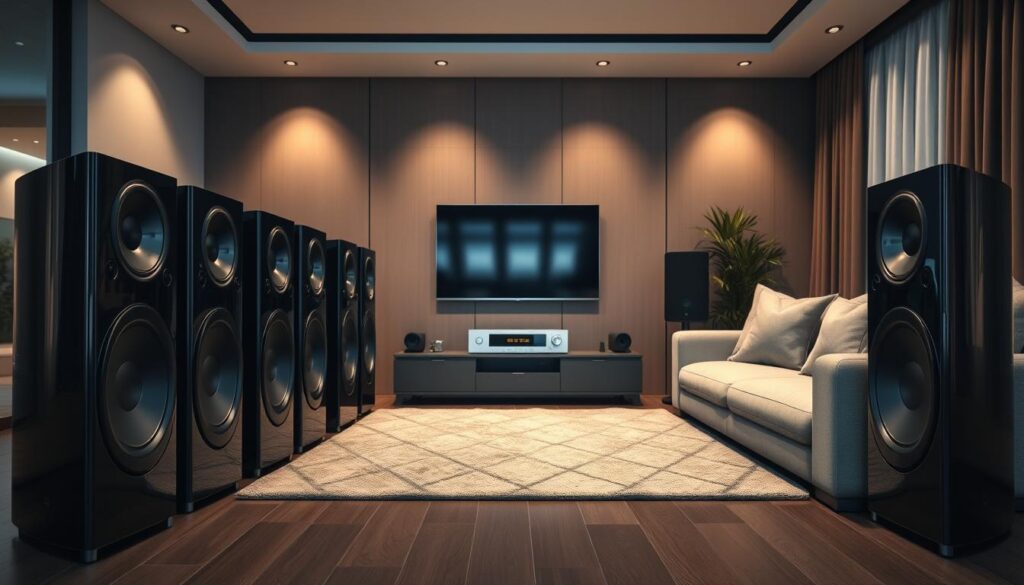
Several manufacturers stand out for strong engineering. Brands like Denon and Marantz earn respect for receivers with advanced room correction and reliable power delivery.
Klipsch and KEF offer speaker choices for different acoustic preferences. Their focus on clarity and dynamic range helps create an immersive environment.
Recommended Models for Different Budgets
Your equipment choice depends on your budget and room size. Focus on HDMI 2.1 support and high-current amplification, not only brand names.
| Tier | Focus | Key Feature |
|---|---|---|
| Entry-Level | Value | Ease of Setup |
| Mid-Range | Performance | Room Calibration |
| Premium | Precision | Advanced Processing |
User Reviews and Ratings
User feedback can guide your final purchase. Reviews reveal how audio technology performs, including long-term heat management and initial setup difficulty.
Reliability matters in any surround sound speaker system. Study how users handle setup and connectivity issues to avoid common problems. This research can help your investment provide years of enjoyment.
Troubleshooting Common 7.1 Surround Sound Issues
When audio output feels wrong, a step-by-step check can reveal the cause quickly. Technical glitches are frustrating, but patience often solves them. Check your surround sound system step by step to restore your immersive sound without professional help.
Connection Problems
Loose or incorrect connections cause many audio problems. Inspect each HDMI cable and make sure it fits firmly in its port. If one speaker is silent, check wire polarity at both ends, making sure positive and negative ends match.
Sometimes, a faulty cable can seem like failed hardware. Swap in a known working cable to rule out broken wires. Also, check that your source device sends the correct signal format to your receiver, preventing handshake errors.
Audio Balance Issues
If sound feels uneven, calibration settings may cause the problem. Run the built-in auto-calibration tool again to check speaker distances and levels for your room. If dialogue sounds muffled, slightly raise the center channel level in your surround sound setup menu.
Too much bass or thin audio often points to wrong crossover settings. Set your subwoofer crossover to the manufacturer’s recommended frequency, typically around 80Hz. These adjustments can greatly improve your overall soundstage clarity.
Receiver Configuration Challenges
Modern receivers have complex menus that can cause configuration errors. Check input assignments, ensuring the right source matches the right audio mode. If you do not hear all seven speakers, check the receiver’s listening mode.
Choose Dolby Surround or DTS Neural:X instead of stereo. If problems continue, factory-reset your receiver as a last resort. This clears conflicting software settings that may cause the issue.
Always isolate the component before replacing hardware to confirm a failure is not a software glitch.
| Issue | Primary Check | Recommended Action |
|---|---|---|
| No Sound | HDMI/Speaker Wires | Reseat cables and check polarity |
| Weak Dialogue | Center Channel Level | Increase dB in speaker settings |
| Uneven Volume | Calibration/Distance | Re-run auto-calibration software |
| Missing Channels | Listening Mode | Switch to multi-channel surround |
7.1 Surround Sound in Home Theaters
Achieving cinema-quality sound at home depends on how we design our space and arrange our equipment. A 7.1 system can bring every movie scene to life with incredible depth.
Designing a Home Theater Space
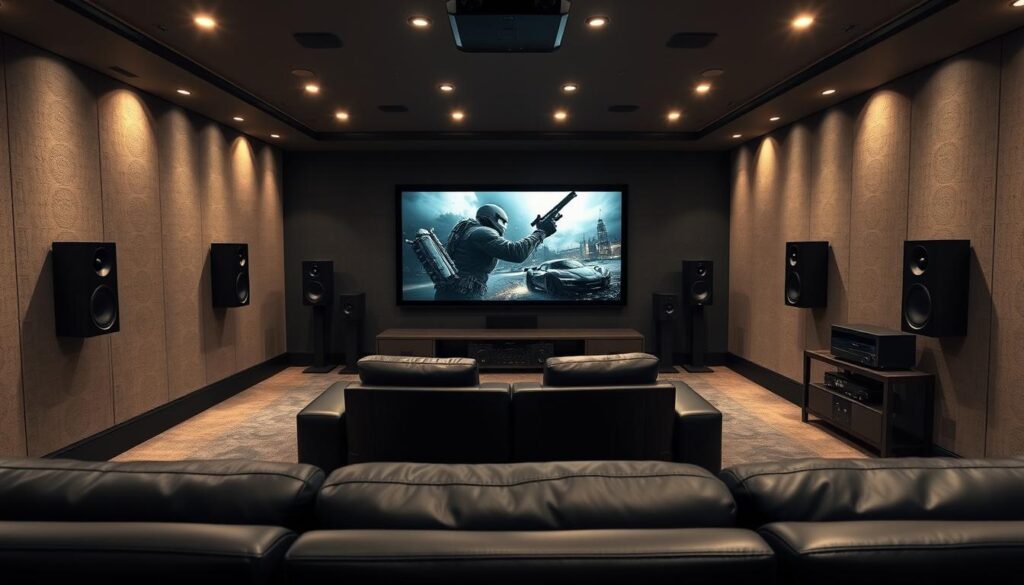
Medium-to-large rooms offer the best space for a 7.1 setup because they allow proper rear-channel separation. We should prioritize acoustic treatment to prevent reflections that can reduce audio clarity. Placing seating at the right distance from the screen helps surround channels feel immersive without overpowering the main audio.
Essential Equipment for Home Theaters
To build a strong system, we need more than speakers. A high-quality AV receiver processes complex signals and delivers home theater audio throughout the room. We must also include a reliable display, a powerful subwoofer, and high-grade cabling to maintain signal integrity throughout the installation.
When selecting components, we should consider the following essentials:
- AV Receiver: Must support 7.1 channel processing and modern formats.
- Speaker Array: Seven matched speakers for consistent tonal balance.
- Subwoofer: A dedicated unit to handle low-frequency effects.
- Source Devices: Blu-ray players or streaming boxes capable of high-bitrate audio.
Enhancing the Viewing Experience
Beyond the hardware, the atmosphere of our theater plays a vital role in our enjoyment. Proper lighting prevents screen glare, while clear sightlines keep furniture from blocking our view or the sound. We recommend a final calibration to balance each speaker’s output and deliver cinema-quality sound in every seat.
Thoughtful planning helps us avoid common problems, such as poor speaker placement and distracting background noise. By investing time in these details, we transform our living space into a true sanctuary for home theater audio enthusiasts.
Future of Surround Sound Technology
Home audio is changing quickly as people seek more immersive sound. We are moving beyond fixed channels toward a more fluid and dynamic listening space. This progress in audio technology places each sound accurately, whatever your room’s size.
Advancements in Audio Formats
For years, Dolby Digital surround sound set the standard for home cinema. It marked a major advance, but fixed channels sent sounds to specific speakers. New formats overcome these limits with a more flexible way to reproduce sound.
“The future of sound is not just about more speakers, but about how those speakers work together to create a believable reality.”
Potential of Object-Based Audio
Modern systems use object-based audio, including Dolby Atmos and DTS:X, to reshape listening. Unlike traditional Dolby Digital surround sound, these formats treat sounds as “objects” moving through three-dimensional space. Adding height to a traditional layout creates a truly hemispherical sound field around the listener.
Metadata makes this possible by telling your receiver where each sound belongs at any moment. It creates a more precise and engaging experience for your speaker setup. The experience adapts to your specific speaker configuration.
Trends in Home Entertainment
Looking ahead, future-ready hardware matters for every enthusiast. When choosing an AV receiver, seek these features to keep your system useful:
- Latest HDMI Standards: Support for high-bandwidth signals to handle future video and audio resolutions.
- Advanced Room Correction: Software that automatically calibrates your speakers to match the unique acoustics of your room.
- Format Versatility: Native support for both object-based and traditional audio formats.
- Expansion Paths: Pre-outs or additional channels that allow you to grow your system over time.
These features help your audio technology investment deliver high-quality performance for years. Following these trends lets us enjoy the most immersive entertainment possible right in our own homes.
Tips for Choosing Audio Content for 7.1 Surround Sound
Not all audio content sounds the same with a high-end surround sound speaker system. To enjoy your investment, learn how to find high-quality tracks that challenge your hardware. Your receiver can simulate depth, but native multichannel content sounds more accurate and immersive.
Best Movies and Shows for 7.1 Audio
For the ultimate cinematic experience, physical media remains king. Blu-ray and 4K UHD discs offer uncompressed tracks that usually beat streaming quality. Many services claim to offer Dolby Digital surround sound, but compression can remove details from a 7.1 mix.
Choose titles in the action, science fiction, or animation genres. These films often feature strong environmental movement. Disc releases give your system the full, discrete channel data that sound engineers intended.
Video Games That Utilize Surround Sound
Modern gaming is perhaps the best way to test your setup. Many AAA titles use complex spatial audio engines to track every footstep, gunshot, and ambient noise in a 360-degree field. These games create a dynamic soundscape that responds to your every movement.
Prioritize games that list multichannel audio support in their settings menu. They provide precise directional cues, which can give you an advantage in fast-paced shooters. You will notice the difference as sounds move smoothly from side speakers to rear surrounds.
Music Formats Optimal for 7.1 Systems
Music is often recorded in stereo, but your receiver can expand its soundstage with advanced processing. Native 7.1 music mixes are rare, so high-resolution files give your receiver the best source material for upmixing. High-fidelity formats like FLAC or SACD provide the depth needed to fill all eight speakers.
For live concert recordings, choose releases mastered for multichannel playback. These tracks often place audience noise in rear channels, making you feel like you stand in the venue’s center. The table compares how different sources work with your hardware.
| Source Type | Audio Quality | Channel Support | Best For |
|---|---|---|---|
| 4K UHD Blu-ray | Lossless | Native 7.1 | Cinematic Movies |
| Streaming Services | Compressed | Dolby Digital surround sound | Casual Viewing |
| High-Res Digital | Lossless | Stereo/Upmixed | Music Listening |
| Modern Gaming | Dynamic | Native 7.1 | Immersive Play |
Conclusion: Transforming Your Audio Experience
Upgrading your home entertainment setup takes careful planning, so every component works well together. A high-quality system grows through thoughtful choices, not one purchase.
Refining Your Soundscape
A true 7.1 surround sound system needs more than extra speakers. Precise placement, room acoustics, and receiver calibration balance the output. Together, these elements reveal more detail that brings movies and games to life.
Strategic Upgrades
Upgrade your equipment gradually as your budget and space allow. Compare how 7.1 surround sound compares with simpler setups, and check whether your room layout supports expansion. Choose quality over quantity for lasting value.
Lasting Audio Quality
A well-configured system delivers an immersive audio experience for years. Choose compatible content and position the subwoofer well to create cinema-quality sound at home. This approach keeps future audio formats possible while maximizing your current gear.