
 Zoe Nora
Did you know sound travels as physical vibrations? Yet, our ears only catch a small part of the vast energy spectrum? Just like radio waves that carry signals worldwide, the sound at the bottom of our hearing range is key to a mix’s power.
We often ignore this foundational element, but it’s the heart of modern music production. Knowing how a low frequency works lets us create tracks that feel huge and in control.
Mastering these deep vibrations gives us full control over our sound. Just as engineers adjust radio waves to clear static, we must fine-tune our audio for clarity. Getting this low frequency right is the first step to a professional sound that connects with all listeners.
Key Takeaways
- Sound energy behaves like electromagnetic signals in the air.
- The bottom end gives a track its essential power and weight.
- Professional mixing means precise control over deep sounds.
- Managing these elements stops muddiness in your final mix.
- A balanced mix starts with a clean and defined base.
What is Low Frequency?
Ever felt the bass drum rumble before you heard it? That’s low frequency energy at work. Sound is a vibration that travels as a wave through the air. By studying these waves, we learn how they affect our world and audio systems.
The Basics of Sound Waves
Sound waves start when an object vibrates. This makes the air around it compress and expand. These movements spread out like ripples in a pond, and their speed affects the pitch we hear.
Low frequency waves vibrate slowly. They have long wavelengths, allowing them to pass through solid objects and travel far. This is similar to how radio waves carry information across long distances.
“Sound is the vocabulary of nature, and low frequencies provide the heartbeat that anchors our entire auditory experience.”
Understanding Frequency Range
We divide sound into bands to manage it better. Humans can hear sounds between 20Hz and 20,000Hz. The lower end is split into two parts that affect the mix’s weight and impact.
| Frequency Category | Range (Hz) | Auditory Characteristic |
|---|---|---|
| Sub-Bass | 20Hz – 60Hz | Physical sensation and deep rumble |
| Standard Bass | 60Hz – 250Hz | Musical warmth and rhythmic foundation |
| Mid-Range | 250Hz – 4,000Hz | Clarity and vocal presence |
Lower Frequencies in Our Daily Life
We meet these deep tones every day, even without music. The hum of big engines, the rumble of thunder, and truck vibrations are all low frequency energy. These sounds often feel in our chests, not just our ears.
Like radio waves, these sound waves interact with our surroundings in complex ways. Knowing this helps us create better spaces and audio equipment. By understanding these basics, we control the foundation of quality audio.
Importance of Low Frequency in Audio
We often overlook the power of low frequency, yet it remains the backbone of professional sound design. This range provides the necessary weight and authority. It transforms a simple recording into a rich, immersive experience. While high-pitched sounds capture our attention, the deeper tones ground the entire audio landscape.
Enhancing the Music Experience
In music production, the low-end is what gives a track its pulse and energy. Without a solid foundation, songs often feel thin or incomplete to the listener. By carefully balancing these frequencies, producers ensure that the rhythm section provides a compelling physical presence that resonates with the audience.
Role in Movie Soundtracks
Movie soundtracks use these ranges to create intense physical sensations. When a cinematic explosion occurs, the deep rumble is not just heard; it is felt in the chest. This visceral impact is essential for drawing viewers into the narrative, much like how radio waves carry signals across vast distances to reach our devices.
Impact on Live Performances
Live performances rely on carefully managed energy to ensure that the crowd feels the music as much as they hear it. Sound engineers work tirelessly to calibrate systems so that the bass frequencies fill the venue without becoming muddy. This creates a unified atmosphere where the audience feels fully connected to the artist on stage.
| Application | Primary Goal | Audience Impact |
|---|---|---|
| Music Production | Rhythmic Foundation | Emotional Engagement |
| Movie Soundtracks | Atmospheric Tension | Physical Sensation |
| Live Concerts | Sonic Immersion | Collective Experience |
How Low Frequency Affects Sound Quality
High-fidelity sound depends a lot on how we handle low frequency signals. Just like scientists study specific parts of the electromagnetic spectrum, audio engineers focus on bass. They make sure it doesn’t overpower other sounds.
Bass Response in Audio Equipment
Good sound needs accurate deep tones. High-quality subwoofers and monitors handle low frequency well. They keep the sound balanced. For better sound, check out 9 home audio setup techniques for small spaces.
Distortion and Clarity Issues
Bad bass management can make mixes muddy and distorted. We use a Low Cut Filter to get rid of unwanted bass. This lets mid and high frequencies be clearer.
Listening Experience and Comfort
A good mix is not just about sound quality. It’s also about how comfortable it is to listen. Too much bass can be tiring. We aim for a mix that’s engaging but not overwhelming.
| Technique | Primary Benefit | Impact on Clarity |
|---|---|---|
| Low Cut Filtering | Removes Muddy Rumble | High Improvement |
| Subwoofer Placement | Reduces Standing Waves | Moderate Improvement |
| Room Treatment | Controls Bass Decay | High Improvement |
Types of Low Frequency Sounds
We often feel low frequency as a deep vibration in our bodies, not just a sound we hear. Like the electromagnetic spectrum, these sounds have a heavy impact on our mood and how we see space.
Natural Sources of Low Frequencies
Nature shows us the power of deep sounds. These come from big movements of air or earth, making waves that travel far.
- Thunderstorms: The deep rumble of thunder is a classic example of low-end energy.
- Seismic Activity: Earthquakes produce infrasonic waves that are felt as tremors before they are heard.
- Animal Vocalizations: Large mammals, such as elephants and whales, communicate using deep frequencies that can travel for miles through land or water.
Artificial Low Frequency Sounds
In modern music, we make deep sounds electronically. Producers use these tools to create the foundation of a track. They make sure the low frequency content has power and character.
Synthesizers help us shape sound waves precisely. We often use sine or triangle waves for a strong sub-bass. By using filters and compression, we control how these sounds mix, avoiding them from getting too loud or muddy.
Examples in Different Music Genres
Different music styles use deep sounds to create their unique feel and emotional impact. Producers pick their sources carefully to match the song’s vibe.
In Electronic Dance Music (EDM), the sub-bass is the track’s heartbeat, made for big club systems. Hip-Hop uses the punchy, sustained decay of 808-style kicks to push the rhythm. Cinematic scores use these deep sounds to build tension, like the fear we feel in intense situations.
Low Frequency in Audio Equipment
Just as we study the electromagnetic spectrum to understand light, we must study our equipment’s frequency response to understand how it handles bass. Achieving a balanced sound requires specialized hardware designed to move large amounts of air efficiently. When we select our gear, we prioritize components that can handle a deep low frequency range without introducing unwanted noise or distortion.
Speakers: The Role of Subwoofers
Standard speakers often struggle to reproduce the deepest notes in a music track. This is where the dedicated subwoofer becomes essential for any high-fidelity system. By offloading the heavy lifting of bass reproduction to a specialized driver, your main speakers can focus on clarity in the mid and high ranges.
You can learn more about how these components interact by exploring the effect of low frequency response in professional setups. A well-placed subwoofer transforms a thin sound into a rich, full-bodied experience that you can physically feel.
Headphones: Bass Response Levels
When it comes to personal listening, the physical design of your headphones dictates the quality of the bass. Larger drivers generally provide a more authoritative low frequency response, but the seal around your ears is equally important. If the seal is broken, the air pressure needed for deep bass escapes, resulting in a hollow sound.
Many modern headphones are tuned to emphasize the low end, providing a punchy feel that many listeners enjoy. But it’s important to ensure this boost doesn’t muddy the rest of the audio spectrum. High-quality drivers maintain tight control over the movement of the diaphragm, ensuring that bass notes remain distinct and fast.
Amps and Equalizers for Low Frequencies
Amplifiers and equalizers serve as the command center for your audio system. An equalizer allows you to fine-tune the output, ensuring that the low end does not overwhelm the delicate details of the music. By adjusting specific bands, you can compensate for room acoustics or personal preference.
We recommend using these tools to create a balanced profile that highlights the depth of the track. Proper configuration prevents the common issue of “boomy” or distorted bass that can ruin an overall perfect mix. The following table outlines how different equipment types contribute to your overall sound profile.
| Equipment Type | Primary Function | Bass Impact |
|---|---|---|
| Subwoofer | Dedicated Bass Output | High (Deep Resonance) |
| Over-Ear Headphones | Driver Air Displacement | Medium (Tight Response) |
| Equalizer | Frequency Balancing | Variable (Control) |
| Amplifier | Power Delivery | High (Stability) |
Measuring Low Frequency Sounds
To get high-fidelity sound, we need precision like in communication technology. We measure sound energy levels to keep our mix balanced and clear. Using objective data helps us avoid guesswork in setting up.
Decibels and Frequency Measurement
We use decibels (dB) to measure sound intensity. This scale shows sound volume compared to a reference point. Knowing these levels helps keep the audio signal strong from start to finish.
Frequency is measured in Hertz (Hz), showing sound cycles per second. For deep bass, we focus on 20Hz to 250Hz. Keeping output consistent in this range is key for a professional sound.
Tools for Measuring Low Frequencies
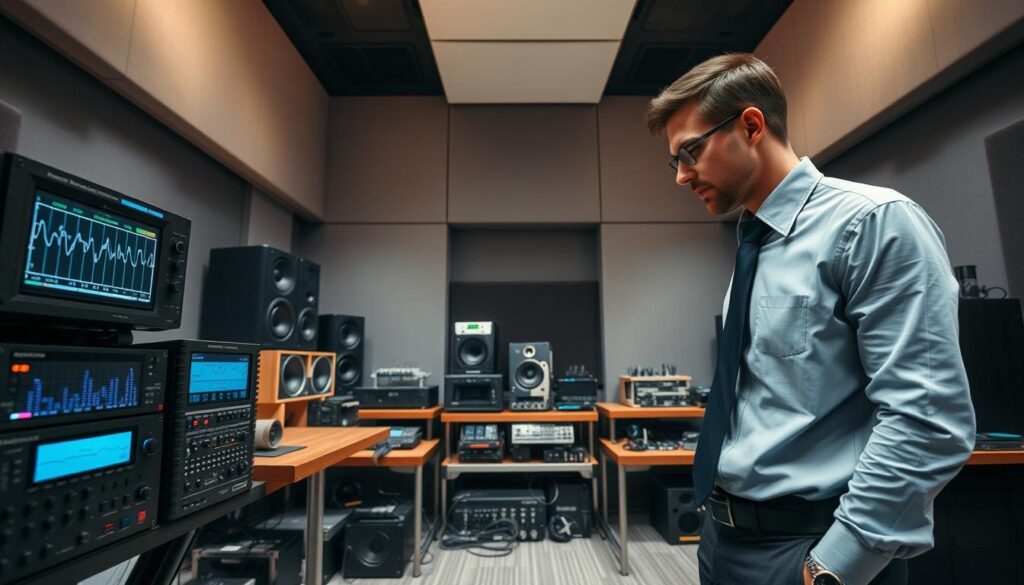
Professional engineers use special tools to get accurate data. Without these, finding phase issues or standing waves is hard. Here are the tools you need for low frequency monitoring:
- Real-Time Analyzers (RTA): These show the frequency spectrum instantly.
- Measurement Microphones: You need mics with a flat response for raw data.
- Acoustic Analysis Software: Programs that test how your room affects your subwoofer with sine sweeps.
Interpreting Frequency Response Graphs
After collecting data, you’ll see a frequency response graph. These charts show sound amplitude across frequencies. They help us see where our system might be off or too strong.
When looking at these graphs, watch for dips or peaks in the bass area. A flat line means your equipment is playing the sound right. By making smart changes based on these charts, you can greatly enhance your audio setup.
Challenges with Low Frequencies
Mastering low frequency waves is key to a clean mix. These long waves can bounce off walls, creating standing waves. This messes with how we hear audio. We must find and fix these problems to keep the sound clear, just like with communication technology.
Room Acoustics and Bass Traps
The room’s layout greatly affects bass sound. Without treatment, sound waves can bounce off walls, causing peaks or nulls. We suggest using bass traps in room corners to soak up this excess energy.
These devices are crucial for controlling the low end. By placing them right, we stop the room from altering the sound. This way, we hear the true sound of the source material.
Dealing with Low-End Muddy Sound
A muddy mix often comes from too much energy in the low registers. We use a frequency sweep to find and fix these issues. This method lets us remove bad frequencies with an equalizer.
“The secret to a powerful low end is not just adding more bass, but ensuring that every element has its own space to breathe.”
By treating the low end, we make the track sound clearer. Just like in communication technology, we need to clear the mix. This lets the kick drum and bass guitar sit right in the mix.
Avoiding Overemphasis on Bass
It’s tempting to add more bass for impact. But too much can cause listener fatigue and sound bad on small speakers. We aim for a balanced sound that feels natural, not forced.
- Use reference tracks to compare your bass levels.
- Check your mix on multiple playback systems.
- Apply high-pass filters to remove unnecessary sub-bass from non-bass instruments.
By staying disciplined, our audio stays tight and professional. A well-managed low end gives a solid foundation for a great sound experience without overwhelming other frequencies.
Benefits of Low Frequencies
Learning to control the low end of sound changes how we hear every day. The low frequency parts give sound its depth and power. This makes the audio feel complete and balanced.
Immersive Audio Experiences
Deep sounds make us feel like we’re right there in the scene. Just like a strong communication technology keeps data flowing smoothly, a solid low end keeps the sound mix grounded and strong.
This makes the experience more immersive. We feel like we’re surrounded by the sound. This makes movies and games feel more real.
Emotional Impact in Music
The bass in a song can really move us. Deep, resonant sounds can change our mood and connect us to the music.
Let’s look at how these elements shape our listening:
- Rhythmic drive: Bass keeps the beat going.
- Atmospheric depth: Sub-bass adds tension or calm.
- Sonic warmth: A good low end makes music feel welcoming.
Greater Engagement in Media
Creators who focus on the low end get more from their audience. When the audio is rich and polished, listeners stay engaged. They don’t get tired or distracted.
Working on low frequency details is key for creators. It makes sure the music or sound touches us deeply. This leaves a lasting impression that regular audio can’t match.
Low Frequency and Health
High-intensity bass can do more than just rattle the walls; it can have measurable effects on your body and mind. While we enjoy deep, immersive audio, we must remain aware of how low frequency energy interacts with our biological systems. Maintaining safe listening habits is the best way to ensure that your passion for sound does not lead to unintended health consequences.
The Effects on Hearing
Just as poor signal reception can lead to data loss in digital systems, excessive exposure to loud, low-pitched sounds can lead to long-term auditory damage. Many people mistakenly believe that only high-pitched noises cause hearing loss. In reality, sustained exposure to high-decibel bass can fatigue the inner ear and potentially cause permanent threshold shifts.
We recommend monitoring your listening environment to keep volume levels within a safe range. Protecting your hearing is a lifelong commitment that allows you to continue enjoying high-fidelity audio for years to come.
Low Frequency Sounds and Stress
Beyond the ears, sound waves can influence our internal state. Research suggests that prolonged exposure to intense, rhythmic low frequency vibrations may trigger a stress response in some individuals. This can lead to increased levels of cortisol, the body’s primary stress hormone, which may affect your mood and focus.
If you find yourself feeling agitated after a long listening session, it might be time to lower the gain. Creating a balanced soundscape is essential for maintaining both mental clarity and physical comfort during your media consumption.
Physical Reactions to Bass Sounds
Our bodies are highly sensitive to vibrations, and lower registers are no exception. When you experience powerful bass, you are often feeling the sound as much as you are hearing it. While this tactile sensation is a key part of an immersive experience, it can also cause physical fatigue if the intensity is too high.
Listen to your body when adjusting your audio equipment. If you notice physical discomfort or tension, take a break to allow your system to recover. By balancing your desire for deep sound with common-sense safety, you can enjoy the best of both worlds without compromising your health.
Popular Myths About Low Frequencies
We need to check our understanding of audio physics to avoid marketing tricks. Many think more low frequency energy means a better mix. But, in professional audio, this is not always true.
Debunking Common Misconceptions
Some believe more bass is always better. But, too much low-end can hide important sounds in the mid and high ranges. Balance is the key to a professional sound, not just power.
Our ears hear sound differently at different volumes. Too much bass can make a mix muddy and unclear.
Understanding Bass Myths in Audio Systems
Many think expensive, high-wattage subwoofers always mean better sound. While good equipment is important, the room and setup matter too.
Think of it like checking your signal reception; poor environment can ruin even the best gear. We should focus on room acoustics and speaker placement, not just wattage.
Low Frequencies and Hearing Loss
There’s a fear that low frequency sounds are more damaging to our ears. But science shows hearing loss is mainly due to sound intensity and duration, not frequency.
Deep bass can be felt, but it’s not more risky than high-pitched sounds at the same volume. Protecting your hearing means managing volume across all frequencies, so we can enjoy music safely for years.
Future of Low Frequency Sound Technology
We are on the edge of a new era in sound technology. Low frequency precision is key to the future of audio. The industry is moving towards smarter, more responsive tools that change how we make and enjoy deep sounds.
This change is not just about power. It’s about achieving unprecedented clarity in all listening settings. By using low-frequency noise reduction, engineers are tackling the long-standing issue of unwanted resonance that muddies sound.
Advancements in Audio Engineering
Modern audio equipment is undergoing a big change. It’s getting better at signal reception and sound quality. We’re seeing a shift towards digital signal processing that adjusts to the room’s physical characteristics in real-time.
These changes ensure sound quality stays balanced, no matter where you listen. Key advancements include:
- Adaptive DSP algorithms that adjust bass output instantly.
- Advanced materials that reduce structural vibration.
- Improved wireless protocols for clear low frequency transmission.
Trends in Musical Production
In the studio, producers focus on clean, impactful low ends. They aim for sound that stands out without distorting. The trend is moving from “louder is better” to dynamic range and spatial accuracy.
“The future of music production lies in the ability to sculpt the sub-bass frequencies with the same surgical precision we apply to vocals.”
This shift requires a deeper understanding of sound and space. Producers use advanced software to control low-end energy in their tracks.
Innovations in Sound Design
New sound design methods are pushing the limits of bass perception. AI-driven tools help designers predict sound behavior in different settings before finalizing it.
These innovations ensure signal reception stays consistent across all playback systems. We believe these tools will lead to a new era of audio excellence, making deep, immersive sound more accessible than ever.
Conclusion: Embracing Low Frequencies in Audio
Mastering the deep end of your audio setup changes how you hear music. To get professional sound quality, you need to understand how sound works in your space. Make sure to balance and be precise when adjusting your equipment.
Every small change in low frequency output affects a song’s emotional feel. By managing these ranges carefully, you can make the music more immersive. This precise control lets your mix connect with listeners on a deeper level.
We encourage you to dive deeper into sound design. Start with simple equalizer tweaks and then explore complex wavelength modulation techniques. These advanced methods let you shape your audio in unique ways.
Your dedication to learning about low frequency dynamics will make your work stand out. Trying out wavelength modulation can open up new creative possibilities. Keep exploring and experimenting to find your unique sound.