
 Zoe Nora
Did you know over 200 million households worldwide use voice-activated tech daily? These devices are super convenient, but setting them up can be tough. We’re here to guide you through your smart speaker setup with ease.
We believe technology should make your life easier, not harder. Our guide is designed to get your device up and running fast. Follow our expert tips to skip the usual setup headaches.
Looking for a hassle-free setup? Our how to set up a smart guide has got you covered. We want to make setting up your home tech as stress-free as possible. Let’s get your system working smoothly today.
Key Takeaways
- Understand the basic requirements for a successful home device installation.
- Learn how to avoid common technical errors during the initial configuration.
- Discover tips for integrating voice technology into your daily routine.
- Follow our step-by-step instructions to save time and reduce frustration.
- Ensure your home network is optimized for the best performance.
What is a Smart Speaker?
A smart speaker is more than a music player. It’s the brain of your connected home. It controls your home and entertainment with just your voice.
Definition of a Smart Speaker
A smart speaker is a wireless device with a virtual assistant. For example, the Nest Audio uses Google Assistant. It responds to your voice and controls smart-home devices.
These devices listen for a “wake word” to start working. Once they’re active, they connect to the internet. They can get information, play media, or adjust your thermostat.
Key Features to Consider
When looking for the best smart speakers, focus on key features. Sound quality is crucial for music lovers. Microphone sensitivity ensures your voice is heard clearly from anywhere.
It’s also important to consider compatibility. You want a device that works well with your current smart devices. This makes your experience smooth and hassle-free.
Popular Smart Speaker Brands
There are a few top brands in the market. Google Nest and Sonos are favorites for their quality and smart features.
| Brand | Primary Assistant | Best Use Case |
|---|---|---|
| Google Nest | Google Assistant | Home Automation |
| Sonos | Alexa/Google | High-Fidelity Audio |
| Amazon Echo | Alexa | Shopping & Skills |
Choosing a brand depends on your preferred ecosystem. Knowing the differences helps you pick the right device for your needs.
Selecting the Right Smart Speaker for Your Needs
Choosing a smart speaker is more than picking a brand. It’s about how it fits into your life. Your voice assistant setup should match your current devices for smooth integration.
Voice Assistants: Alexa, Google Assistant, or Siri?
The heart of your experience is the voice assistant’s smarts. Google Assistant shines for music lovers, accurately playing songs.
Alexa from Amazon has a huge skill library. Siri is great if you’re all in on Apple. Your choice affects how your voice assistant setup handles daily tasks and smart home commands.
Size and Design Considerations
Choose a device that looks good and sounds clear. Bigger speakers offer richer audio output, perfect for living rooms or kitchens.
Smaller speakers are ideal for tight spaces like bedrooms or offices. Think about the aesthetic appeal to match your decor.
Budget-Friendly Options
Quality smart features don’t have to be expensive. The $100 Nest Audio is a great mid-range pick, offering great sound and design.
The Google Nest Mini is a compact, affordable choice. It’s perfect for starting small and growing your system later.
Initial Setup: Unboxing and Preparing Your Smart Speaker
A successful smart speaker setup starts before you plug it in. Organizing your workspace makes the process smooth and stress-free. This smart speaker installation guide helps you avoid common issues and get your device up and running quickly.
What’s in the Box?
First, check that all parts are in the box. You should find the speaker, a power adapter, and a quick-start guide.
Save the box for a few days in case you need to return or exchange it. Make sure the power cable is not damaged before connecting it.
Gathering Necessary Tools and Equipment
You need a stable Wi-Fi connection and your smartphone ready. For Google smart speakers, ensure your phone has the latest Google Home app.
Your phone or tablet must run Android 9.0 or later for full compatibility. Having your Wi-Fi network details ready will save time during setup.
Choosing the Right Location in Your Home
Where you place your smart speaker is key for the best performance. Pick a central spot where it can easily hear you.
Avoid loud appliances and thick concrete walls that can block signals. This ensures your speaker works well.
| Requirement | Importance | Action Item |
|---|---|---|
| Wi-Fi Network | High | Verify signal strength |
| Mobile App | Critical | Update to latest version |
| Power Source | High | Use provided adapter |
| Placement | Medium | Select central, quiet area |
Connecting Your Smart Speaker to Wi-Fi
Setting up a smart speaker starts with a good internet connection. A strong wireless link is key for updates and voice processing. Without it, your speaker can’t access online services.
Steps to Connect to Your Home Network
First, make sure your phone or tablet is on the same Wi-Fi as your speaker. Open the app and follow the instructions to find your speaker. Pick the Wi-Fi band that works best in your room.
“A robust network connection is the invisible thread that ties your entire smart home ecosystem together, ensuring that every command is executed without delay.”
Troubleshooting Common Wi-Fi Issues
If you can’t connect, check your router settings or restart it. Other devices might be causing signal problems. Keep your router’s software updated for the best performance.
| Wi-Fi Band | Best For | Range | Speed |
|---|---|---|---|
| 2.4 GHz | Long-distance coverage | High | Moderate |
| 5 GHz | High-speed streaming | Low | Fast |
| Mesh System | Large homes | Excellent | Very Fast |
Importance of a Strong Wi-Fi Signal
A strong signal is crucial for smooth voice commands and music streaming. A weak signal can cause delays or broken audio. Place your speaker near your router for the best experience.
Linking Your Smart Speaker to Your Smartphone
Your smartphone is the command center for your new smart speaker. Connecting them is easy. This step is the last one to turn on your device and use all its features. After linking, your phone becomes the main remote for settings, updates, and permissions.
Downloading the Required App
Every smart speaker has a special app for your phone. First, find and install this app on your device. Here’s how to start:
- Open the App Store on iOS or the Google Play Store on Android.
- Look for the app for your speaker brand, like Google Home.
- Tap the install button and wait for it to appear on your screen.
Signing In and Setting Up Your Account
After installing, open the app to set it up. You’ll need to sign in with an account or make a new one. Creating a dedicated account is key. It keeps your settings and streaming services safe.
Follow the app’s instructions to verify your email or phone number. Once logged in, the app will find your speaker. This seamless integration makes your device ready to use right away.
Device Compatibility: What You Need to Know
Before setting up, check if your phone meets the system requirements. Most smart speakers need a certain OS version to work. If your phone is too old, pairing might not work.
Make sure your phone is up to date. Here are some things to check:
- Your phone should have the latest iOS or Android.
- Make sure Bluetooth is on, as it’s used to find the speaker.
- Ensure your phone is on the same Wi-Fi network as your speaker.
Keeping your phone’s software current helps with a smooth and reliable connection. If problems arise, restarting your phone might fix them.
Personalizing Your Smart Speaker Experience
A smart home starts when your device learns your family’s voices. By refining your voice assistant setup, your speaker becomes more personal. It moves from generic answers to tailored help for your daily life.
Customizing Voice Settings
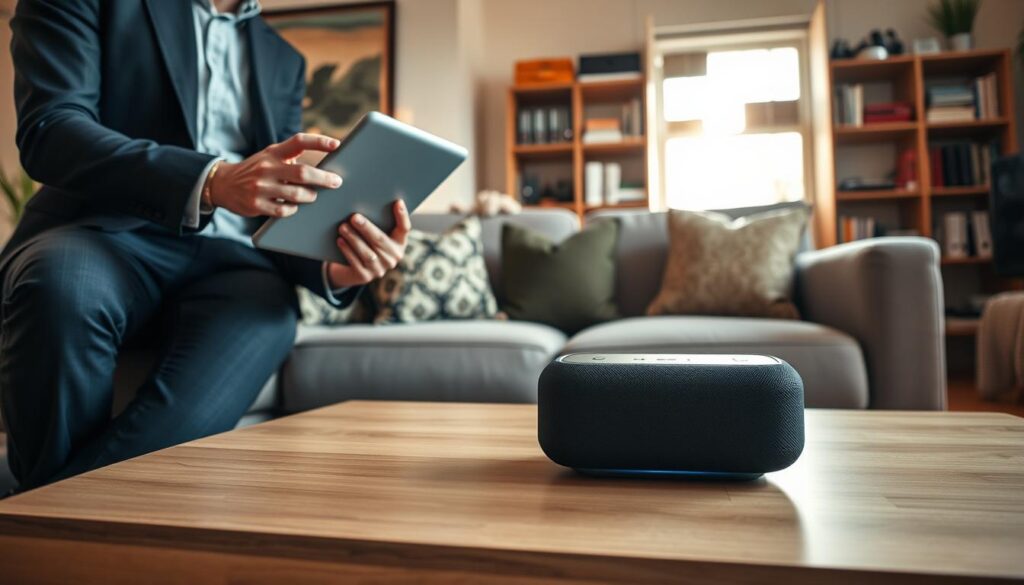
Adjust your speaker’s interaction through the app. Change the voice, volume, or language to fit your needs. Customization makes the tech feel like part of your home.
For better sound, consider upgrading your home audio. These small changes make your device sound and work just right for you.
Setting Up Voice Recognition
Teach your device to recognize individual voices. During setup, choose Voice Match for personal voice recognition. This keeps your info safe and private.
With these features, your device gives tailored responses that respect your privacy. Manage these settings in the app for full control over your data. It’s a simple way to keep your home organized and secure.
Adding Multiple Users
Smart speakers are meant to be shared. Adding users makes it useful for everyone. Each person gets their own music, contacts, and schedules.
Follow the official guide for multi-user support. This turns your speaker into a central hub for your family. It’s great for shared tasks or personal playlists, making your voice assistant setup efficient for all.
Integrating Smart Home Devices with Your Speaker
Connecting smart home devices with your speaker makes home management easy. Your speaker acts as the brain of your home. It lets you control your space with just your voice.
Compatible Smart Home Products
Many gadgets work well with your speaker system. You can link smart bulbs, thermostats, cameras, and locks. Google Cast technology is in many devices, like TVs and soundbars, for audio setups.
Check for the “Works with” label to ensure compatibility. This ensures your smart home devices work with your setup. Once connected, you control your home network easily.
Setting Up Routines and Automation
Routines save time and make life easier. You can set your speaker to do many things with one command. For example, “goodnight” can turn off lights, lock doors, and lower the thermostat.
These routines reduce the need for manual changes. Customize them in your speaker’s app to fit your schedule. Consistency in routines makes your home more connected.
Managing Devices with Voice Commands
Clear voice commands are key to managing smart home devices. Name your devices clearly, like “Living Room Lamp.” This helps your voice assistant know what to control.
Grouping devices by room makes commands simpler. For example, “Turn off the kitchen.” This keeps your home organized. Here’s how different devices work together:
| Device Category | Primary Function | Control Method |
|---|---|---|
| Smart Lighting | Adjust brightness and color | Voice or App |
| Smart Thermostats | Regulate home temperature | Voice or Schedule |
| Security Cameras | Monitor home activity | Voice or Live Feed |
| Media Players | Stream audio and video | Voice or Cast |
Adding Music and Streaming Services
Start using your smart speaker to its fullest by linking your favorite streaming services. This turns it into a powerful audio hub that listens to your voice commands.
Linking Music Service Accounts
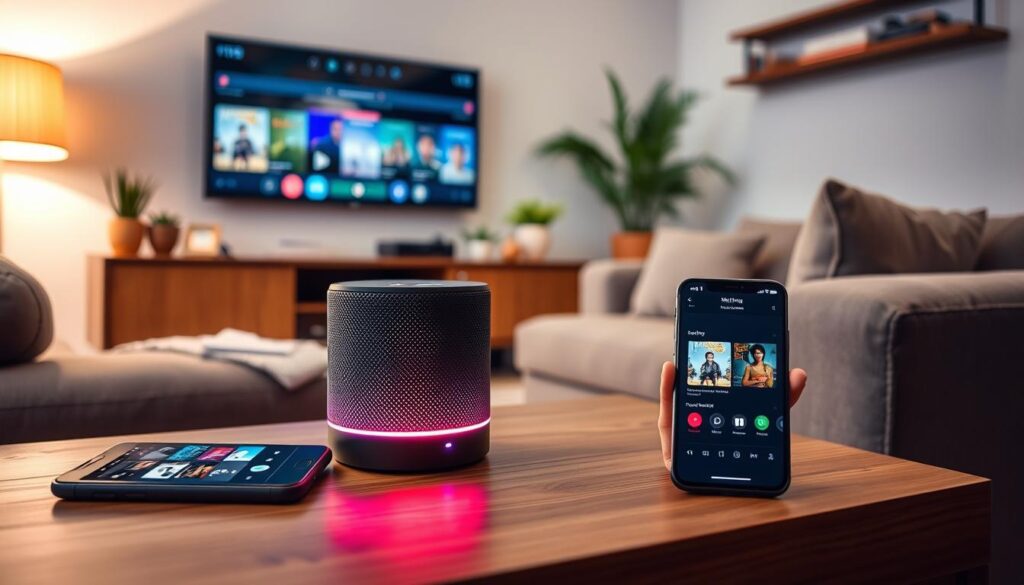
Many platforms, like Google Home, support a variety of services. You can connect accounts like Apple Music, Deezer, iHeartRadio, Pandora, Spotify, and YouTube Music through your phone’s app.
Just go to the services menu in your app, pick your favorite provider, and log in. This makes your music library accessible with just a voice command.
Setting Default Music Providers
You don’t have to say the app name every time you want music. By setting a default music provider, your speaker will play music from your chosen service automatically.
“Music is the shorthand of emotion, and technology is the bridge that brings it into every corner of our homes.”
This saves time and keeps your music playing smoothly. Whether you’re in the kitchen or living room, your music starts with just a command.
Creating Playlists and Favorites
Managing your music lets you create the perfect mood for any moment. You can make playlists of your favorite songs or mark albums for easy access.
This makes it easy to switch between different types of music. By keeping your collections up-to-date, your personalized audio experience is always ready with just a voice command.
Troubleshooting Common Setup Issues
Even the most seamless smart speaker setup can hit a snag. These devices are designed for ease, but sometimes minor technical hurdles occur. Stay calm and follow a systematic approach to solve most problems quickly.
Resetting Your Smart Speaker
If your device won’t respond or sync, a factory reset is often the best fix. This clears your settings for a fresh start.
To reset a Google Home Mini, find the factory reset button below the power cord. Press and hold it for exactly 15 seconds until you hear a confirmation sound.
Addressing Connectivity Problems
Many users find their device not showing in the app during setup. First, check if your smartphone is on the same Wi-Fi network as the speaker.
Also, make sure your phone’s Bluetooth is working. Sometimes, turning Bluetooth off and on again can help connect the devices.
Getting Help from Customer Support
If resets and network checks don’t work, it’s time to contact the manufacturer. Their support teams can find hardware faults you can’t see.
Before calling, have your device’s serial number and model ready. Customer support representatives can guide you through advanced diagnostics to fix your setup.
Exploring Advanced Features of Smart Speakers
You can turn your smart speaker into a powerful home manager. After setting it up, you’ll find tools to make your life easier. These features help you get the most from your smart speaker and keep your home tech up-to-date.
Voice-Controlled Shopping
One cool feature is voice-controlled shopping. You can buy things just by talking to your speaker. This is great for busy homes that need to restock quickly.
But don’t worry, there’s a safety feature too. You can set a voice confirmation code to prevent accidental buys. It’s a good idea to check your settings to make sure it’s set up right for you.
Using Skills or Actions for Added Functionality
Your smart speaker can do more than just answer questions. You can add third-party skills or actions to make it do more. For example, you can get guided meditation or play trivia games.
Look for new skills in your app to find what you need. Want to know the traffic or learn a new language? There’s probably a skill for that. Customizing your device makes it feel like it’s just for you.
Keeping Your Device Updated
Keeping your smart speaker updated is important. Manufacturers often release updates with new features and security fixes. This keeps your speaker safe and working well.
Usually, your speaker updates itself when it’s quiet. But it’s a good idea to check your app now and then. This way, you keep your home tech secure and efficient for a long time.
Enjoying Your Smart Speaker: Tips and Tricks
Your device is now ready to change your daily life. We think learning to use these tools makes your home more responsive.
Mastering Natural Voice Commands
Talk to your Amazon Echo or Google Nest like you would a friend. Using natural language makes talking to them easy and natural. Clear commands help them understand you better, without any hassle.
Discovering Practical Daily Uses
Use your speaker to start your day off right. Set timers for coffee or check the weather. You can also get quick news updates while getting ready for work. These small steps save time and keep you in the loop all day.
Building Family Engagement
Make your speaker a part of family fun. Play trivia games or create music playlists together. Everyone can help with shopping lists or set reminders for chores. Smart home devices bring your family closer together. Try out these features to make your speaker a key part of your home.