
 Zoe Nora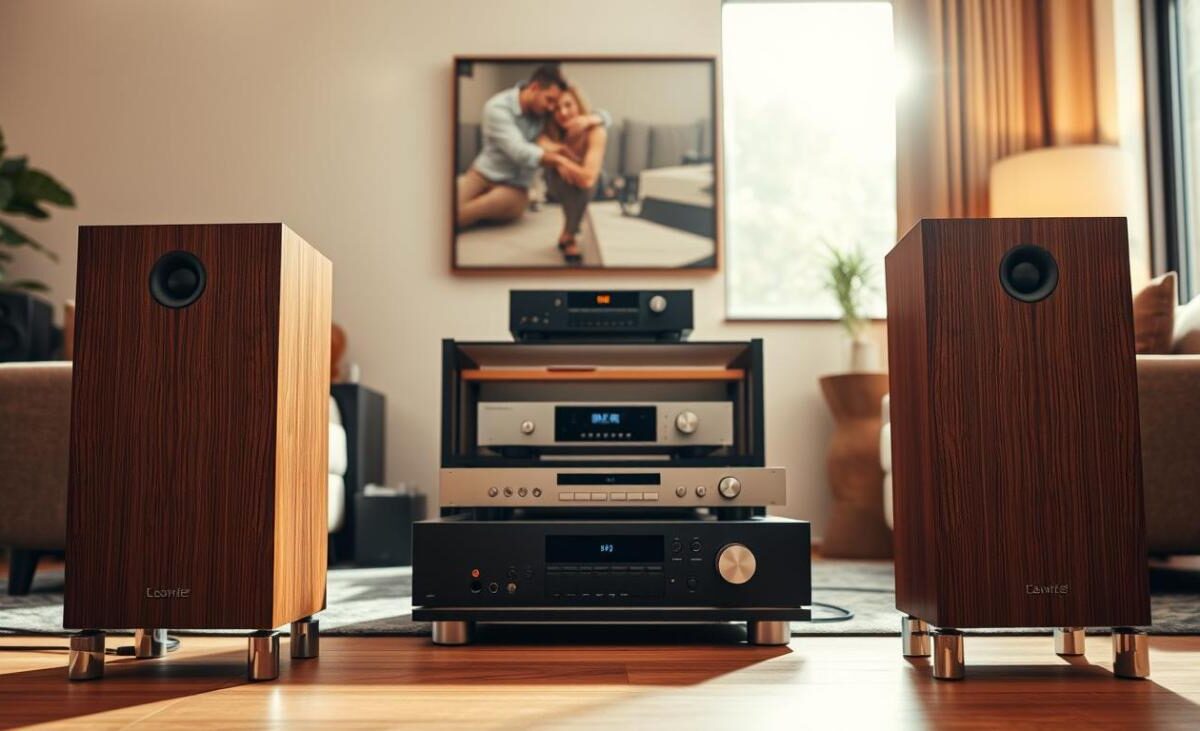
Did you know NASA launched two spacecraft to capture 3D sun images? Like those twin probes, your home audio needs two channels for a truly immersive soundstage.
Passive stereo speakers are the best for music and movie fans. They let you control your sound environment by separating amplification from the cabinet.
Finding the best passive stereo speakers involves several technical factors. We’ll look at room size, amplifier compatibility, and impedance. Our guide will help you get audiophile-grade sound on any budget, whether for a theater or a cozy listening spot.
Key Takeaways
- Separate channels provide superior spatial depth for music and film.
- External amplification offers greater flexibility than powered alternatives.
- Room dimensions dictate the ideal size and power requirements.
- Matching impedance ensures your equipment runs safely and efficiently.
- Budgeting for quality cables and placement is just as vital as the hardware itself.
What Are Passive Stereo Speakers?
If you’re setting up a top-notch home audio system, you’ll likely run into passive stereo speakers. These are basically empty boxes with drivers inside that make sound. Since they don’t have power, they need an outside amp or receiver to work.
Definition and Functionality
At their heart, these speakers are where your audio signal ends up. You connect them to an amp with speaker wire. This wire carries the power needed to move the sound cones.
This setup is crucial for keeping the sound clear. It also lets you set up your system in many ways.
Think of these speakers like the NASA STEREO spacecraft. Just as those probes create a full picture from two angles, your left and right speakers make a complete soundstage. By placing them right, you get an immersive sound experience.
Differences from Active Speakers
The main difference is that active speakers have built-in amps. You can plug them into a wall outlet and a source device. On the other hand, passive stereo speakers need an external amp that fits their power needs.
This setup is great for upgrading your system. You can change your amp without replacing your speakers. Here’s a table showing the main differences between passive and active speakers:
| Feature | Passive Speakers | Active Speakers |
|---|---|---|
| Power Source | External Amplifier | Built-in Internal Amp |
| Connectivity | Speaker Wire | Line-level Cables |
| Upgradability | High (Modular) | Low (Integrated) |
| System Complexity | Higher | Lower |
Choosing passive stereo speakers means you control your audio setup. It takes more work to set up, but you can tweak every part. This ensures your system sounds just right.
Benefits of Using Passive Stereo Speakers
Building a high-fidelity sound system starts with understanding why passive speakers are a top choice. These systems use external amplifiers, giving us control over the audio chain. This setup allows us to fine-tune every aspect of our sound.
Improved Sound Quality
The main advantage of these systems is the potential for superior sonic clarity. With the amplifier separate, we can choose one that matches our speakers perfectly. This creates a more accurate sound, like how data channels help us understand complex phenomena.
Using high-quality passive stereo speakers keeps the signal path clean. Proper placement in the room enhances the soundstage, giving us a three-dimensional audio experience. This precision is hard to achieve with all-in-one active solutions.
Greater Customization Options
Passive setups offer unmatched flexibility for those who love to upgrade their gear. We’re not stuck with a single amplifier design. Instead, we can swap out cables, pre-amps, or power amplifiers to match our preferences or room acoustics.
This modular approach lets our system grow with our collection. We can try different amplifiers, like tube for warmth or solid-state for tight bass. This freedom is a key benefit of high-quality passive stereo speakers.
Cost-Effectiveness
Many think professional audio needs a huge budget, but it’s not always true. We can find affordable passive stereo speakers that perform well with a good entry-level amplifier. Investing in speakers first gives us a solid foundation that lasts.
Also, upgrading components individually means we don’t have to replace the whole system when technology changes. This makes passive setups a wise financial choice for home audio enthusiasts. The table below shows the main benefits of this modular approach.
| Feature | Passive System | Active System |
|---|---|---|
| Component Upgrades | Highly Flexible | Limited/None |
| Amplifier Matching | User-Selected | Fixed/Internal |
| Long-term Value | High | Moderate |
| System Complexity | Moderate | Low |
Key Features to Look For
Understanding passive stereo speaker technology is key to a top-notch home audio system. Look beyond the looks of the cabinet. Focus on the tech specs to ensure your high-quality passive stereo speakers work well in your space.
Speaker Size and Design
The size of a speaker affects its sound and how it fits in a room. Bigger speakers can produce deeper bass. Compact designs are better for small rooms where space is limited.
Check the materials of the cabinet too. A sturdy, well-made cabinet helps the sound stay clean. Make sure the speaker size matches your room to avoid sound issues.
Power Handling and Sensitivity
Power handling shows how much wattage a speaker can handle from an amp. It’s important to know the difference between peak and continuous power. Sensitivity tells you how well a speaker turns electrical power into sound.
Speakers with high sensitivity need less power to get loud. Those with low sensitivity need more power. Always look at real-world performance, not just marketing numbers.
Impedance Ratings
Nominal impedance shows how much electrical resistance a speaker has. Most systems work best with speakers rated at 4, 6, or 8 ohms. Make sure your amplifier matches your speaker’s impedance for stable performance.
Using a speaker with too low impedance can damage your equipment. Always check the specs to ensure a safe match. Here’s a table to help you compare before buying.
| Feature | Low Value Impact | High Value Impact |
|---|---|---|
| Sensitivity | Requires more amplifier power | Efficient with small amplifiers |
| Impedance | Demands high-current amplifiers | Compatible with most receivers |
| Cabinet Size | Better for small, tight spaces | Provides deeper bass response |
| Power Handling | Risk of clipping at high volume | Handles dynamic audio peaks |
Top Passive Stereo Speakers on the Market
Looking for the best passive stereo speakers? It’s key to know how brands perform in real life. We’ve checked out several top brands to give you the lowdown on their sound and build. We looked at specs like sensitivity and impedance to see which fit your room and amp best.
“The goal of high-fidelity audio is to recreate the artist’s intent with absolute clarity and minimal coloration.”
Review of KEF Q350
The KEF Q350 shines among top passive stereo speakers thanks to its Uni-Q driver array. This setup puts the tweeter right in the center of the bass cone. It creates a wide, natural soundstage. It’s perfect for medium-sized rooms and needs a solid amp to handle its 8-ohm impedance.
Review of ELAC Debut 2.0 B6.2
For great value, check out the ELAC Debut 2.0 B6.2 in our passive stereo speaker reviews. These speakers offer a balanced sound that’s great for music and movies. Their sturdy build keeps resonance low, so your sound stays clean even at high volumes.
Review of Klipsch RP-600M II
Klipsch is a top passive stereo speaker brand for those who love a lively sound. The RP-600M II is high-sensitivity, perfect for amps with less power. It’s great in big rooms, where its horn-loaded tweeters can send sound far with clear detail.
- KEF Q350: Best for precise imaging and soundstage depth.
- ELAC Debut 2.0 B6.2: Best for neutral, accurate sound reproduction.
- Klipsch RP-600M II: Best for high efficiency and dynamic performance.
Setting Up Passive Stereo Speakers
Getting high-quality sound means paying attention to how you set up your gear. With passive stereo speakers, where you put them affects the sound quality. Take time to adjust your room before setting up.
Placement Tips for Optimal Sound
For the best sound, place your speakers the same distance from where you sit. This symmetrical arrangement helps sound reach your ears evenly. Also, try a slight “toe-in” angle to make the sound clearer.
“The room is the most important component in your audio system, as it shapes the final output of every note you hear.”
Don’t put your speakers against a wall, as it can make the bass sound muddy. Pull them out a bit to let the rear ports breathe. This balance is key for the best sound from your passive stereo speakers.
Wiring and Connectivity Options
Connecting your gear right is as important as where you put it. Make sure to match the positive and negative terminals correctly. Wrong polarity can make the sound thin and lacking in impact and definition.
Use good binding posts for your cables to ensure a strong connection. Avoid running speaker wires near power cables to prevent interference or hum. Clean, organized signal paths help your passive stereo speakers sound their best.
Matching Passive Speakers with Amplifiers
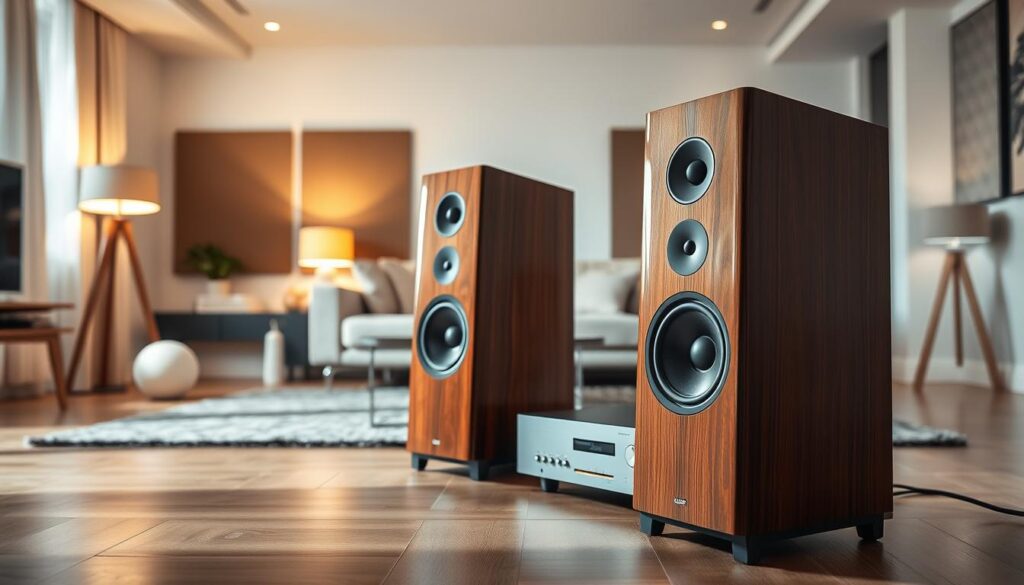
Getting the right power flow is key for top-notch passive stereo speaker technology. When we connect things, we need to make sure the amp gives enough clean power. This keeps your gear safe and your sound clear.
Importance of Matching Specs
Impedance and power handling are crucial for a stable system. If your speakers’ impedance is too low for the amp, it might get too hot or turn on protection. Always check the nominal impedance to make sure it’s safe for your receiver.
Speaker sensitivity also matters a lot. High-sensitivity speakers need less power to get loud, perfect for small rooms. But, low-sensitivity speakers need more power to sound good during loud sessions.
Recommended Amplifiers
Choosing the right amp depends on your room size and how you listen. For small spaces, a compact integrated amp works well. But, big rooms need high-current amps to keep sound levels even.
Don’t make the mistake of underpowering your speakers. This can cause clipping, which sends distorted signals and can harm your speakers. A well-matched amp keeps your passive stereo speaker technology safe and sound clear.
| Room Size | Speaker Demand | Recommended Amp Type |
|---|---|---|
| Small (Bedroom) | Low/Medium | Class D Integrated |
| Medium (Living Room) | Medium | Class AB Stereo Receiver |
| Large (Home Theater) | High | High-Current Power Amp |
Maintaining Your Passive Stereo Speakers
Keeping your sound system in top shape is easy with a few simple steps. By following these habits, your passive stereo speakers will keep playing great music for years.
Cleaning and Care Tips
Dust is a big problem for audio gear. Use a soft, dry microfiber cloth to clean the outside of your passive stereo speakers often. Stay away from harsh chemicals, as they can harm the finish.
For the grilles, a vacuum with a soft brush on low works well to get rid of dust. Make sure your speakers have proper ventilation by keeping the area around them clear. Also, check your cables for fraying or oxidation to keep the sound quality high.
Common Issues and Solutions
If you hear distortion or sound drops out, don’t worry. It’s usually an easy fix. First, check your connections. Make sure all wires are in tight and the polarity is right on both sides.
If the problem still exists, try swapping the left and right cables. This can help you figure out if the issue is with the source, the amp, or the passive stereo speakers. If you think there’s damage to the drivers, look in your manual for how to fix it or get it repaired.
How to Enhance Your Audio Experience
Getting a true soundstage is more than picking top-notch passive stereo speaker technology. We need to add other parts to make our sound better fit our listening spots.
Adding Subwoofers
When your speakers can’t hit the lowest notes, a subwoofer is key. It adds the low-frequency extension we need. It’s important to manage the bass right, so your speakers can focus on the mid and high notes.
Make sure your crossover settings are just right. Wrong settings can mess up the sound. Also, where you place the subwoofer in the room affects the bass quality.
Incorporating Soundbars
Soundbars are great for TV watching, not so much for music. They make dialogue and movie sounds clearer. But, mixing them with your passive stereo speaker technology can cause problems.
Soundbars and speakers process audio differently. This can lead to duplication or synchronization problems. It might mess up the sound quality.
For a better home theater, stick with one system. Using a dedicated receiver with your speakers usually works better than trying to mix a soundbar with them.
Budget-Friendly Passive Stereo Speakers
We think everyone should enjoy great sound, no matter their budget. You can create an amazing sound experience without spending too much. Many affordable passive stereo speakers offer clear and deep sound, just like pricier options.
Recommendations for Various Price Points
Start by looking at different price ranges: entry-level, midrange, and value-focused. Entry-level speakers are great for small spaces or desks. They’re often part of mini speaker systems guides.
Midrange speakers have better construction, like real wood finishes. This improves sound quality and looks.
Top passive stereo speaker brands have a “value-focused” line. These models mix great sound with a fair price. Look for brands that focus on driver quality, not fancy features.
Finding Good Deals
Don’t just look at the price. Think about the total system cost, including an amplifier and cables. A cheap speaker might need an expensive amplifier to sound good, which can be a waste of money.
When buying, consider these points:
- Warranty Coverage: Make sure the maker backs their product for at least two years.
- Return Policies: Buy from places that let you test speakers at home.
- Upgrade Potential: Pick models that can grow with your system.
Also, look at refurbished or open-box deals from trusted sellers. They often come with warranties and save you money. With patience and research, you can find exceptional audio that fits your budget.
Comparing Passive and Active Speakers
When setting up a high-fidelity audio system, you’ll face a choice between passive and active designs. A passive stereo speaker comparison shows the main difference is in signal processing and amplification before you hear it.
Pros and Cons of Each Type
Passive speakers need an external amplifier to work. This gives unmatched flexibility for those who love to tinker. But, it makes setup more complex.
Active speakers, on the other hand, have built-in amplifiers. This ensures optimal power matching and simplifies setup. They’re great for small spaces but can’t be upgraded like passive systems.
The sound quality of these systems is also different. Passive setups use two separate paths for sound processing. Active systems use digital signal processing for precise frequency management.
| Feature | Passive Speakers | Active Speakers |
|---|---|---|
| Amplification | External Required | Built-in |
| Customization | High | Low |
| Setup Ease | Complex | Simple |
Which is Right for You?
Choosing depends on what you want from your home audio. If you like component flexibility and can upgrade later, passive speakers are better.
If you want a streamlined, minimalist setup that saves space, active speakers are the way to go. Think about your space and comfort level before buying. A good passive stereo speaker comparison helps ensure your choice fits your listening needs.
Conclusion: Choosing the Right Passive Stereo Speakers
Creating a top-notch sound system means paying close attention to your room size and what you want to hear. It’s smart to do a detailed comparison of passive stereo speakers. This ensures your speakers fit your space perfectly.
Your budget and how well your speakers work with your amplifier are also key. These factors help you get clear, rich sound.
Think about NASA’s STEREO-A and STEREO-B missions. They show that what matters is what something can do now, not what it was called before. So, judge each speaker by how well it performs today.
Looking at verified measurements is a good way to find what you need. Hearing speakers in person lets you see how they sound to you. A good system can grow with you, improving as your tastes change.
Choose equipment that can grow with you. Making smart choices is the first step to better sound. Start exploring different setups to find what you like best.