
 Zoe Nora
Did you know nearly 90% of professional mix errors are missed until the music hits a car stereo or club system? This is because many creators use gear that distorts the sound rather than showing it as it really is.
Getting Powered studio monitors is the best way to make sure your music sounds great on any device. These tools act like a clear window into your project. They point out harsh sounds and balance problems before you finish your work.
Finding the best powered monitors for your space is more than just looking at the price. You need to think about your room size, what you need to connect to, and how it sounds. This helps you get a setup that you can really rely on.
We want to help you create a space that is dependably accurate. By focusing on getting the sound right, not just loud, you can turn your home into a professional studio.
Key Takeaways
- Accurate speakers reveal mix flaws before your music reaches the public.
- Room size and acoustic treatment are vital for optimal performance.
- Prioritize flat frequency response over high volume levels.
- Connectivity options should match your existing audio interface.
- Budget-friendly options can still provide professional results with proper placement.
Understanding Powered Studio Monitors
Knowing how your speakers work is key for mixing well. The right gear in your studio affects your final sound. The last part of the signal chain is where the magic happens.
What Are Powered Studio Monitors?
Powered studio monitors, or active monitors, have their own power inside. They’re different from regular speakers because they don’t need an external amp. This setup means the amplifier and drivers work together better.
To use them, just plug them into a power outlet and connect your audio cables. This makes them great for producers who want good sound without a lot of equipment.
How They Differ from Passive Monitors
Passive monitors need an external amp to work. You have to match the amp’s power and impedance to the speakers. This can be tricky and might harm your sound.
Active studio monitors make this easier. Since the amp is built-in, you don’t have to worry about matching. This simplifies your setup and lets you focus on your music.
Benefits of Using Powered Studio Monitors
Using active studio speakers has many benefits. They save space because you don’t need extra amps. This is perfect for small studios where space is limited.
These speakers also give you consistent sound. They use active crossovers to handle frequencies better. Investing in good active studio speakers means your setup will be reliable and professional for a long time.
The Importance of Accurate Sound Reproduction
When you mix, the sound system’s accuracy is key. Using professional studio speakers lets you hear your audio as it truly is. This is crucial for spotting issues that might not show up on other systems.
Importance in Mixing and Mastering
In mixing, you need to tweak balance, tone, and instrument separation with care. Studio monitor speakers for mixing give you the flat sound needed for making these adjustments. Without this, you might mess up the sound by boosting or cutting the wrong frequencies.
Mastering is even more critical, focusing on dynamic range and stereo imaging. Good speakers help you catch small details and spatial errors. This ensures your master sounds great on any system.
Enhancing Your Listening Experience
Accurate monitors offer a better soundstage than headphones. They create a real sound space in your room. This lets you hear music in a more natural way, enhancing your connection to it.
The right equipment is crucial for your work. Here’s why:
| Feature | Accurate Monitors | Consumer Speakers |
|---|---|---|
| Frequency Response | Flat and Neutral | Boosted Bass/Treble |
| Stereo Imaging | Precise and Wide | Narrow and Blurred |
| Dynamic Range | Highly Detailed | Compressed/Limited |
| Primary Use | Critical Listening | Casual Enjoyment |
Investing in studio monitor speakers for mixing boosts your creativity. It keeps your vision clear from start to finish. Professional studio speakers give you the reliable sound needed for top-notch mixes.
Key Features to Look for in Powered Studio Monitors
Starting your sound journey means looking at the core parts of your system. While knowing the brand is good, the real performance of active studio monitors comes from their engineering. Don’t just look at the wattage; think about how they’ll work in your space.
Active vs. Passive Components
These units have a big plus: they have built-in amplifiers. This means the amplifier and driver work together perfectly. You avoid the problems of matching external power. This setup gives you clear, high-quality sound without needing big external equipment.
When you compare models like the Eris e3.5, you see how the internal electronics handle signal processing. This lets you control the sound exactly, which is key for mixing. If you want more choices, check out different desktop speakers to see how they stack up against professional ones.
Speaker Size and Design
The size of the woofer affects how your room handles bass. Smaller drivers are great for close, near-field setups. Bigger drivers give deeper bass. Think about the cabinet design too, like if it’s front- or rear-ported.
Front-ported speakers work better if you have to put them near a wall. Rear-ported ones need more space to avoid bass buildup. Make sure the studio monitor speakers can play all the frequencies of your audio well.
Connectivity Options
Professional setups need clean, interference-free signal paths. Most top active studio monitors have balanced inputs like XLR or TRS. These are better than unbalanced RCA or auxiliary cables because they block interference.
For example, the JBL LSR305 has many input options for easy connection with professional audio interfaces. Make sure your monitors match your equipment’s inputs. Using balanced cables makes your sound clearer.
| Feature | Professional Standard | Entry-Level Standard |
|---|---|---|
| Input Type | Balanced XLR/TRS | Unbalanced RCA |
| Amplification | Bi-Amplified | Single Amp |
| Port Design | Front-Ported | Rear-Ported |
| Acoustic Control | Room Correction EQ | Fixed Response |
Top Brands of Powered Studio Monitors
Finding the best powered monitors means looking at what each top brand offers. Each brand has its own way of making sound, which can really affect how you mix music.
Yamaha
Yamaha is known for making sound that is neutral and true to life. The Yamaha HS7 is a favorite in many studios because it doesn’t change the sound in a way that’s not natural.
If you want your mixes to sound good on other systems, Yamaha is a great choice. Their monitors are perfect for when you need to hear the sound as it really is, without any extra flair.
KRK
KRK is known for its bright yellow woofers and a sound that’s rich in bass. Many hip-hop and electronic music producers love these speakers for their strong, bass-forward sound.
These speakers are not just fun to listen to, they’re also great for making music. They help you feel the beat of your music, even during long sessions.
JBL
JBL has made a name for itself with its wide sound dispersion. The JBL LSR305 is a great example of this, offering a huge “sweet spot” for consistent sound, even if you move around.
These monitors are some of the best powered monitors for small rooms. They’re perfect for places where it’s hard to get the sound right. They’re also good for many different audio tasks because they sound balanced.
Audioengine
Audioengine combines high-quality sound with ease of use for home studios. Their designs are often smaller and look good, making them great for people with limited space.
They offer a sound that’s warm and inviting, making them easy to listen to for a long time. If you need a reliable, easy-to-use monitor, Audioengine is a great choice.
| Brand | Primary Strength | Best For |
|---|---|---|
| Yamaha | Neutrality | Critical Mixing |
| KRK | Bass Response | Electronic Production |
| JBL | Imaging/Waveguide | Accurate Soundstage |
| Audioengine | Compact Design | Home Studio/Casual |
Comparing Budget-Friendly Options
Creating a professional home studio doesn’t have to empty your wallet. Many producers find that studio monitor speakers of high quality are affordable. By looking for value, you can set up a reliable monitoring system without spending too much.
Best Choices Under $300
The PreSonus Eris e3.5 is great for small spaces. These compact speakers offer clear sound at a low price. They’re ideal for bedroom producers, helping beginners mix well.
If you have more room, the JBL LSR305 is a good choice. These powered studio speakers are known for their strong bass and wide sound area. They perform well, often better than more expensive options.
Essential Features to Consider
When looking at affordable gear, focus on neutrality over fancy features. A flat frequency response ensures your music sounds good on other systems. Make sure the speakers have the right connections for your setup.
Size matters in small studios. Choose studio monitor speakers that fit your desk without clutter. Proper placement is key, just like the quality of the speakers.
Pros and Cons of Budget Monitors
Budget-friendly speakers often have trade-offs. They might use lighter materials or simpler parts to save money. But, you can still make a professional-sounding mix if you know your gear’s quirks.
The main benefit of these powered studio speakers is they’re easy to get started with. They might not have the deep bass of expensive models. But, they give you the accuracy you need to learn. Investing in these tools lets you focus on your creativity, not technical issues.
Mid-Range Powered Studio Monitors Worth Considering
Many creators find that mid-range powered studio speakers offer a great balance. They cost less than top models but still deliver professional-grade sound. This is a key investment for anyone serious about their work.
Notable Models Between $300 – $700
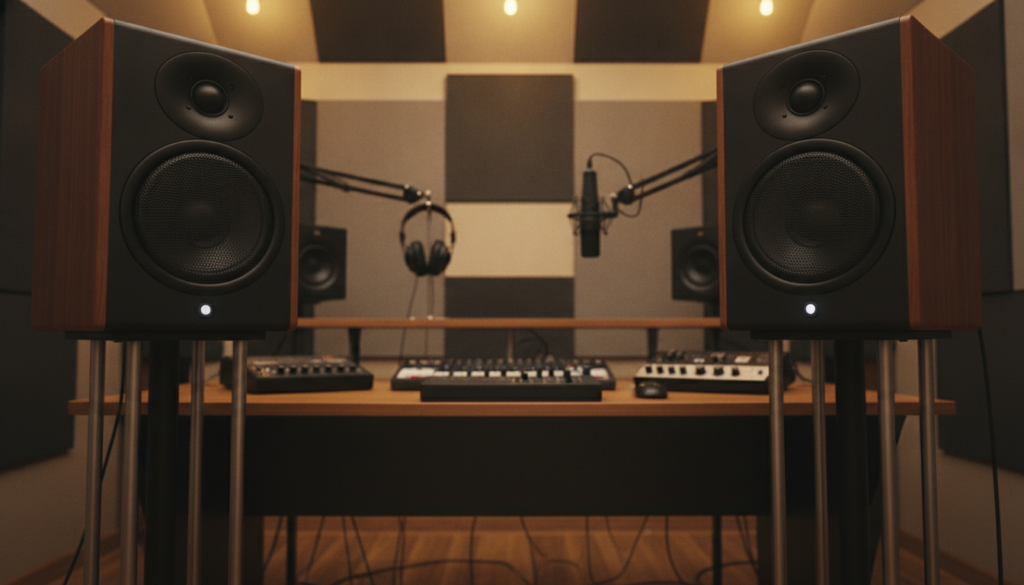
The FiiO SP3 is a standout for its size and power. It packs 80 watts of power and fits on small desks without losing clarity. It’s perfect for those with limited space but high standards.
The Yamaha HS7 is another top choice for those with more room. These monitors are known for their flat frequency response. They give you the honest feedback you need to tweak your tracks.
Key Features of Mid-Range Monitors
Mid-range monitors offer better resolution and bass. You’ll notice your sound is more precise, with instruments placed accurately. The cabinets are also stronger, reducing unwanted vibrations.
“The quality of your monitoring environment is just as important as the speakers themselves. Even the best gear will struggle if your room acoustics are not addressed.”
Remember, a higher price doesn’t mean better sound. Focus on room compatibility and tonal accuracy. Test these powered studio speakers in your space to see how they work.
| Model | Power Output | Best Use Case | Key Strength |
|---|---|---|---|
| FiiO SP3 | 80 Watts | Desktop/Small Studio | Compact Design |
| Yamaha HS7 | 95 Watts | Professional Mixing | Flat Response |
| KRK Rokit 7 | 145 Watts | Electronic Production | Bass Extension |
High-End Studio Monitors for Professionals
For those who spend their lives in the studio, high-end powered studio monitor speakers are a must. They offer sonic truth that standard gear can’t match. This is crucial for professionals who need to make precise decisions.
Leading Models Over $700
The market for premium audio gear is vast. But, brands like Adam Audio, Focal, JBL, and PSI Audio stand out. They offer professional studio speakers for the most demanding conditions.
These monitors are tested in acoustically treated environments. They meet the highest standards of performance. Whether you’re mastering a track or mixing a film score, these models provide the clarity needed.
Why Invest in Top-Tier Monitors?
Investing in top-tier monitors offers more than just better volume or bass. You get superior imaging and distortion control. This ensures every sound is exactly as intended.
| Feature | Standard Monitors | High-End Monitors |
|---|---|---|
| Transient Response | Average | Exceptional |
| Imaging Precision | Good | Reference Grade |
| Distortion Levels | Noticeable at high gain | Near-zero |
| Frequency Accuracy | Colorized | Flat/Neutral |
Even the most expensive powered studio monitor speakers can’t fix a poor room. Proper acoustic treatment is key. Make sure your monitor size fits your space to avoid inaccurate monitoring.
Setup and Positioning for Optimal Performance
Getting clear sound starts with how you set up your space and handle room acoustics. Many producers spend a lot on gear but forget about the room. A professional studio monitor placement guide can help you get the most from your equipment.
Best Practices for Monitor Placement
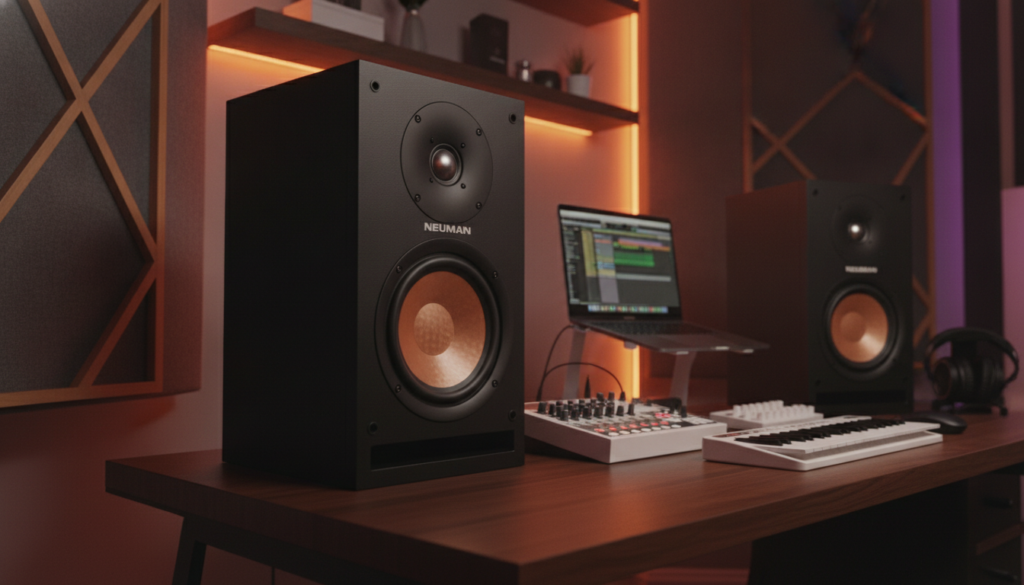
For a balanced sound, place your active studio speakers in an equilateral triangle with you. Each speaker should angle inward, with tweeters aimed at your ears. This setup creates a clear “sweet spot” for sound.
It’s also key to keep speakers away from walls, if they have rear ports. Too close and you get muddled bass. Keep them a few feet from corners to avoid sound reflections.
Dealing with Room Acoustics
Even top gear can struggle in a bad room. Use software like Room EQ Wizard to find sound issues. This helps you place acoustic panels where they’re needed most.
“The room is the most important piece of gear in your studio, as it dictates how every sound wave behaves before it reaches your ears.”
Fixing early reflections and standing waves makes your room neutral. This lets your high-quality studio monitors accurately share your sound with others.
Using Isolation Pads
Vibrations from your desk or stands can mess with your sound. High-density isolation pads keep your active studio speakers steady. This step sharpens your low-end and makes your sound clearer.
- Ensure stands are heavy and stable to prevent cabinet movement.
- Use foam or rubber pads to absorb mechanical energy.
- Verify that your listening height matches the tweeter axis for the best frequency response.
Maintenance Tips for Your Studio Monitors
Keeping your powered studio monitor speakers in top shape is key. Regular cleaning and smart use habits help them stay reliable. Simple steps can prevent damage and keep your sound quality high.
Regular Cleaning and Care
Dust is a big problem for sensitive electronics. Use a soft, dry microfiber cloth to clean the outside and around the drivers. Stay away from harsh chemicals or liquids, as they can harm the speakers.
Good airflow is also important. Make sure there’s enough space behind the speakers for heat to escape. This prevents overheating. For better airflow, consider using best wall mount speakers for your space.
Always turn on your monitors last and off first. This protects them from power surges.
Troubleshooting Common Issues
Hum or buzz? It’s not always a hardware problem. Often, it’s due to ground loops or bad cables. Check your balanced cables first, as they help reject interference.
Weak bass or stereo issues? Check your room setup before blaming the speakers. Moving them a bit can change the sound. Make sure connections are tight and gain settings are correct.
| Maintenance Task | Frequency | Action Required |
|---|---|---|
| Dust Removal | Weekly | Use a dry microfiber cloth |
| Cable Inspection | Monthly | Check for fraying or loose pins |
| Ventilation Check | Quarterly | Clear debris from rear ports |
| Connection Test | As Needed | Verify balanced signal integrity |
User Recommendations and Reviews
Finding the right audio gear is tough. Online forums and social media are full of advice. But, to find high-quality studio monitors that fit your needs, you need to look beyond the trends.
What Audiophiles Are Saying
Experienced engineers say long-term testing is key. They talk about brands like Adam, Focal, JBL, and PSI Audio. These brands offer different ways to hear sound.
Audiophiles value neutrality and resolution. They say these qualities help avoid mixing fatigue. When reading reviews, pay attention to comments on bass and how the monitors sound in different rooms.
Remember, what sounds great in a showroom might not in your home studio. Always check how the monitors fit your room and listening preferences.
Influencer Picks for Powered Monitors
Influencers can be a good starting point. But, their picks should be seen as suggestions, not the only truth. They might choose monitors based on looks or sponsorships, not just sound quality.
For a balanced view, check out the best budget studio monitors. This can help you see how entry-level gear compares to professional options.
When choosing high-quality studio monitors, focus on facts, not just hype. Here’s a table to help you understand different monitor designs:
| Monitor Brand | Primary Strength | Best Application |
|---|---|---|
| Adam Audio | High-frequency detail | Critical mixing |
| Focal | Mid-range clarity | Detailed vocal work |
| JBL | Wide sweet spot | General production |
| PSI Audio | Phase accuracy | Mastering environments |
The right choice depends on your setup and music type. By combining expert reviews with your own tests, you’ll find high-quality studio monitors that boost your creativity.
Final Thoughts on Choosing the Right Powered Studio Monitors
Choosing the right audio gear is all about knowing your production space. It’s about finding the right mix of technical specs and the space you work in. This balance is key to getting professional sound.
Summary of Key Takeaways
Small rooms, like 10 by 10 feet, do well with compact speakers. These prevent sound from bouncing back too much. Medium rooms, around 12 by 12 feet, can handle more varied speaker sizes.
Larger rooms, 14 by 14 feet or bigger, are perfect for high-end systems. But, no matter the size, placing speakers right and using acoustic treatment is crucial. It ensures your sound is accurate.
Making the Best Choice for Your Setup
Before buying, think about your budget and what you want to achieve. For beginners, Audioengine offers great value. For those growing, Yamaha or JBL is a good choice. The right monitors help bring your creative vision to life.
Finding the right powered studio monitors is essential for your production needs. Try out different models to see what sounds best to you. Making a smart choice today is the first step to better audio.