
 Zoe Nora
Did you know over 70% of home audio fans prefer compact systems over big floor speakers? These versatile audio solutions are great for saving space while still delivering top-notch sound. They’re perfect for any room in your home.
Looking to upgrade your TV setup, computer area, or music room? These units bring amazing clarity to your audio experience. We divide them into two types: powered models with built-in amps for easy setup, and passive ones that let you pick your own gear.
In this guide, we look at sound quality, connectivity, and size to help you choose wisely. We also talk about how to place them and how to keep them in top shape. Our aim is to help you find the ideal bookshelf speakers stereo that matches your style and budget.
Key Takeaways
- Compact audio systems offer high-quality sound without requiring significant floor space.
- Powered models simplify the installation process by integrating amplifiers directly into the hardware.
- Passive units provide audiophiles the flexibility to choose their own external amplification components.
- Proper placement and room acoustics significantly influence the overall performance of your audio gear.
- Our comprehensive reviews evaluate connectivity, build quality, and value to simplify your purchasing decision.
What Are Bookshelf Speakers?
Bookshelf speakers are a special type of audio equipment. They offer high-quality sound without taking up too much space. These speakers are a compact alternative to big floor-standing speakers. They can still fill a room with clear, detailed sound.
Definition and Purpose
These speakers are small stereo units made to produce full-range sound. They are designed for spaces where there’s little room. Their main goal is to give you an immersive listening experience.
“The best audio systems are those that disappear into the room, leaving only the music behind.”
High quality bookshelf speakers focus on efficiency and precision. They let you enjoy top-notch sound without the need for big cabinets. They are key for many home theaters and music setups.
Key Features to Consider
When picking your speakers, look at a few key technical aspects. These include the cabinet size, driver setup, and how well the speakers handle different frequencies.
- Amplification: Active designs have built-in power, while passive ones need an external amp.
- Connectivity: Look for options like analog, digital, or phono inputs for vinyl fans.
- Sensitivity: This tells you how much power your speakers need to reach certain volume levels.
Choosing high quality bookshelf speakers depends on how these features match your room and audio sources. Whether you want a simple wired setup or the flexibility of digital inputs, there’s a model for you.
The aim is to find a balance between looks and sound quality. By focusing on these key features, you make sure your speakers will give you years of great listening.
Advantages of Bookshelf Speakers
Thinking about upgrading your home audio? You might wonder if smaller speakers can really deliver a top-notch sound. Bookshelf speakers for home audio strike a great balance between size and sound quality. They offer a rich listening experience without taking up too much space.
Space Efficiency
These speakers are perfect for small spaces. You can put them on bookshelves, desks, or media consoles. Proper placement is key, as many models need a few inches from the wall to sound clear.
Sound Quality
Many people are amazed by the clear sound of bookshelf speakers for home audio. They might not have the deep bass of a big subwoofer. But they offer a balanced and clear sound profile. This makes them great for smaller rooms where you don’t need to blast the music.
Versatile Placement Options
These speakers are very flexible. You can mount them on stands or fit them into an entertainment center. The table below shows how different placements affect your listening experience.
| Placement Method | Acoustic Benefit | Space Requirement |
|---|---|---|
| Speaker Stands | Optimal imaging and height | Moderate floor space |
| Bookshelf/Desk | Saves floor area | Minimal footprint |
| Wall Mounts | Clears all surface space | Requires wall hardware |
Popular Brands of Bookshelf Speakers
When you start looking for the best bookshelf speakers, you’ll see many well-known names. While a brand’s reputation is important, it’s not everything. You should also look at the technical details and how they fit in your space.
Don’t just look at the brand name. Check things like how the speakers are made, what connections they have, and what kind of warranty they offer. This helps you find speakers that really meet your needs. Whether you’re looking at high-end or affordable options from brands like Victrola, Edifier, or HiVi-Swans, aim for the best mix of quality and price.
KEF
KEF is famous for its Uni-Q driver array. This design puts the tweeter right in the middle of the midrange cone. It makes the sound spread out evenly, filling your room with clear audio. KEF’s focus on precise engineering makes them a top choice for those who want accurate sound.
Bowers & Wilkins
If you want premium aesthetics and top-notch sound, Bowers & Wilkins is the way to go. They use advanced materials in their tweeter domes to cut down on distortion, even at loud volumes. Their speakers are often the centerpiece of a room, combining stylish looks with detailed sound.
Audioengine
Audioengine is great for those who want an easy setup. They make active speaker systems with built-in amps and wireless options. These are perfect for modern setups, whether it’s for your desk or a small room. Check out professional reviews to see how these brands stack up.
Your choice should match your lifestyle. While big brands offer reliability and quality, make sure the model fits your needs. Look at things like connectivity and power needs. This way, you’ll get the most out of your speakers for years to come.
Factors to Consider When Buying
When you’re looking to buy new speakers, start by thinking about your space. For those searching for bookshelf speakers under $200, focus on sound quality. Don’t spend extra on features that don’t enhance your listening experience.
Budget
First, decide how much you want to spend. For bookshelf speakers under $200, you can find great options. These speakers offer clear sound for music or desktop use. Spending wisely means you get value without paying too much for brand names or looks.
Room Size
The size of your room affects what speakers you need. Small rooms do well with compact speakers, while bigger rooms need speakers with larger drivers. Also, how far you sit from the speakers matters. Sitting too far can make the sound less clear and loud.
Connectivity Options
The back of your speakers shows how they connect to your setup. Modern speakers often have Bluetooth for easy wireless use. They also have optical or USB-C inputs for stable connections to TVs and PCs. If you might add a subwoofer later, look for a subwoofer output for better bass.
| Connection Type | Best Use Case | Primary Benefit |
|---|---|---|
| HDMI eARC | Television | Single remote control |
| Bluetooth | Mobile Devices | Wireless freedom |
| Phono Input | Vinyl Turntables | Direct analog playback |
Types of Bookshelf Speakers
Finding the right audio equipment can be tricky. It’s all about knowing the different types available. Whether you need something simple for your desk or a full home theater, picking the right design is crucial. This ensures you get affordable bookshelf speakers that suit your needs.
Active vs. Passive
The main difference between active and passive speakers is how they get power. Active speakers, also known as powered speakers, have an amplifier built-in. This makes setting them up easier since you don’t need extra equipment.
Passive speakers, on the other hand, need an external amplifier or a multichannel receiver to work. While this adds a piece to your setup, it gives you more flexibility. Many people find passive speakers to be great affordable bookshelf speakers when paired with a budget-friendly receiver.
| Feature | Active Speakers | Passive Speakers |
|---|---|---|
| Amplification | Built-in | External Required |
| Setup Complexity | Low | Moderate |
| Upgrade Path | Limited | High |
Wired vs. Wireless
Wireless technology has made audio systems more convenient. But, it’s key to know what “wireless” really means. Most systems use Bluetooth or Wi-Fi to stream audio from devices. Yet, they’re not completely cordless.
- Power Requirements: Even wireless speakers need a power cable plugged into a wall outlet.
- Speaker Connections: In many stereo pairs, a physical wire is still required to connect the left speaker to the right speaker.
- Streaming Convenience: Wireless features allow you to play music without connecting a source device directly to the amplifier.
Knowing these differences helps you find the perfect affordable bookshelf speakers for you. Whether you like the ease of active units or the flexibility of passive systems, there’s something for everyone.
Setup and Installation Tips
Getting high-quality sound starts with careful setup. When you buy top rated bookshelf speakers, how you place them matters a lot. Follow these tips to get the best sound from your speakers.
Positioning for Optimal Sound
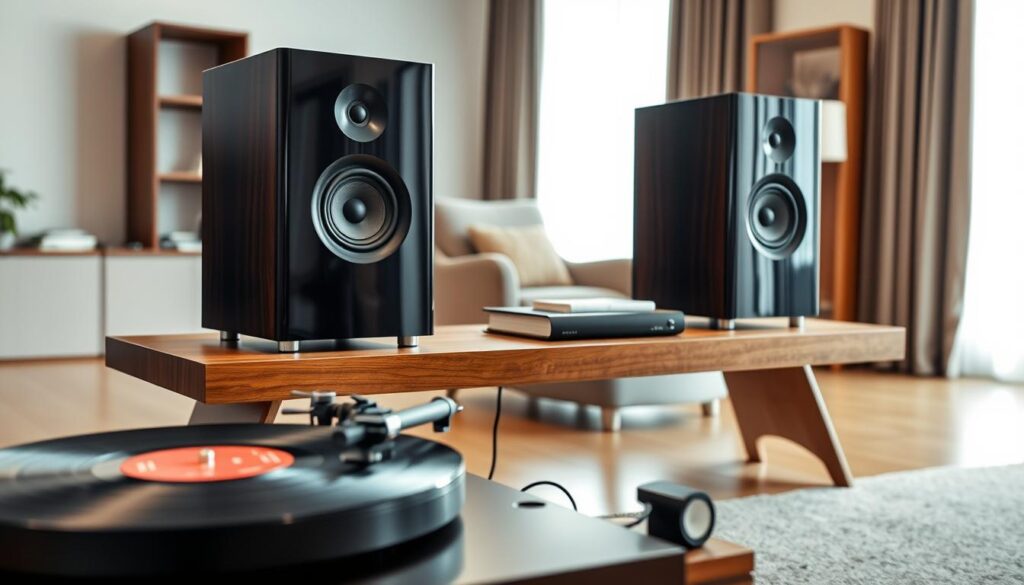
Place your speakers on stable, vibration-free stands. Make sure the tweeters are at ear level for clear highs. Keep them at least six inches from the back wall to avoid bad bass and sound muddiness.
For a balanced sound, create an equilateral triangle with the speakers and your listening spot. Too close, and the sound feels narrow. Too far, and there’s a “hole” in the music.
Connecting to Audio Sources
Connecting your speakers is easy with today’s tech. Use analog RCA cables for turntables or optical cables for digital TV audio. USB and Bluetooth are great for computer and mobile streaming.
Make sure you’ve picked the right input on your speakers or amp. If it’s a passive system, connect the speaker wire correctly. A bad connection can mess up your sound.
| Connection Type | Best For | Audio Quality |
|---|---|---|
| Analog (RCA) | Turntables | Warm/Classic |
| Optical (Toslink) | TV/Gaming | Clear Digital |
| Bluetooth | Mobile Devices | Convenient |
| USB | Computers | High-Res |
Troubleshooting Common Issues
Even top systems can have small problems. Weak bass or thin sound? Check for reversed speaker polarity. This mistake cancels out your sound.
Distortion or missing audio? Check your source and volume. For Bluetooth issues, try restarting. Keep your speakers’ firmware up to date for better performance.
Best Bookshelf Speakers of 2023
Finding the perfect audio setup means looking at the best bookshelf speaker reviews. We’ve analyzed the market to give you a detailed comparison for 2023. Always check product availability and model generations before buying to get the latest tech.
Top Picks Overview
We chose speakers based on versatility, sound quality, and value. Our top picks are divided into three tiers to match your home audio needs. Whether you want broad connectivity or compact performance, these models are the best in the industry.
In-Depth Reviews of Each Model
The Victrola Tempo is our top pick for flexibility. It has extensive connectivity options and a dedicated subwoofer output. It’s perfect for a growing home theater system.
The Edifier M90 offers a premium experience. It supports HDMI eARC and comes with a remote. It delivers clear audio that justifies its high price.
The HiVi-Swans OS-10 is great for those on a budget. It doesn’t have HDMI, phono, or USB inputs. But, it has a strong measured response that beats many competitors at its price.
| Model | Key Feature | Best For |
|---|---|---|
| Victrola Tempo | Subwoofer Output | Versatility |
| Edifier M90 | HDMI eARC | Clarity |
| HiVi-Swans OS-10 | Low Price | Budget |
This comparison shows that the right speaker depends on your needs. Make sure to check your devices before buying to ensure they work together well.
How to Enhance Your Listening Experience
Getting the best sound from your speakers can be a small tweak away. Bookshelf speakers are great at clarity, but they might miss the deep bass. By tweaking your setup, you can make the most of your audio equipment.
Adding a Subwoofer
If your speakers can’t handle the lowest notes, a subwoofer is key. It lets your main speakers focus on the mid and high sounds. This makes the sound more balanced and immersive.
How you connect your gear matters. For example, the Victrola Tempo uses a 116-hertz filter, while the Edifier M90 has a simpler setup. Choosing the right connection keeps your sound clear and prevents muddiness in the bass.
Using an AV Receiver
An AV receiver is crucial, even with passive speakers. It controls everything, from switching sources to managing volume. This is great for setting up a home theater system.
Today’s receivers also have room calibration software. This adjusts the sound to fit your space perfectly. Using a receiver lets you control the sound in every corner of your room.
Speaker Placement Tips
Where you place your speakers is key to great sound. Don’t put them against walls to avoid bass buildup. Try different spots and angles to find the best sound for you.
For tips on placing your speakers, check out where to place bookshelf speakers for the best sound. Also, follow 8 home audio setup tips to improve your listening area. Even small changes can make a big difference in sound quality.
Maintenance Tips for Bookshelf Speakers
Proper care and routine maintenance are key to keeping your high-fidelity audio equipment in top shape. By spending a little time on upkeep, you ensure your speakers deliver clear, immersive sound for years. This way, you get the most out of your investment.
Cleaning Your Speakers
When cleaning your speakers, use a soft, dry microfiber cloth to wipe the exterior cabinets. This is true whether your speakers have a black, white, blue, or green finish. A gentle touch helps avoid scratches and keeps the speakers looking great.
Be very careful when cleaning the drivers and ports. Avoid pushing dust or debris into the delicate diaphragms. This can seriously harm sound quality. If your speakers, like the Edifier M90, don’t have a grille, be extra cautious. The exposed tweeter is very sensitive and can be damaged easily.
“Regularly dusting your equipment prevents the buildup of particles that can eventually work their way into internal components and affect performance.”
Regular Maintenance Checks
Do more than just clean your speakers. Regularly check that every part of your system is working right. Look for signs of wear on your cables and make sure all power connections are secure. This helps prevent signal drops.
Don’t overlook your input connections. For example, the Tempo uses robust RCA jacks. These are designed like those on high-end audio components, ensuring reliability if kept clean and free of oxidation.
Here’s a checklist to keep your system in top shape:
- Ventilation: Make sure there’s enough space around the rear ports to prevent overheating.
- Input Reliability: Periodically unplug and replug cables to clear any minor corrosion from the contact points.
- Cabinet Condition: Check the housing for any loose screws or signs of moisture damage.
- Stability: Make sure the speakers are firmly on their stands or shelves to avoid unwanted vibrations.
Understanding Speaker Specifications
When you look for bookshelf speakers, you’ll see lots of numbers. These numbers are not random. They help you understand how a speaker will sound in your home. Learning to read these numbers helps you find the right speakers for you.
Impedance
Impedance is measured in ohms and shows how much a speaker resists the flow of electricity. Most speakers are 8 ohms, but some are 4 or 6 ohms. Lower impedance means the speaker needs more power from your amplifier.
If your amplifier can’t handle low-impedance speakers, it might get too hot or sound distorted. Always check if your receiver can handle the speakers you want. Matching these values correctly keeps your system safe and efficient.
Sensitivity Ratings
Sensitivity shows how loud a speaker can get with a certain amount of power. A higher sensitivity means the speaker needs less power to be loud. This is good if you have a low-wattage amplifier or a small desktop unit.
Speakers with lower sensitivity need more power to sound good. Knowing this helps you avoid using too little power. Efficiency is key for clean, dynamic sound without overworking your equipment.
Frequency Response
Frequency response shows the range of sounds a speaker can make, measured in Hertz (Hz). While a wide range is nice, how smooth that range is matters more. A speaker that sounds natural and even across all sounds is better than one with uneven peaks and dips.
Remember, room acoustics affect how you hear these sounds. Use these numbers as a guide, but always trust your own ears. The table below shows how different models compare in technical specs.
| Model | Impedance (Ohms) | Sensitivity (dB) | Frequency Range (Hz) |
|---|---|---|---|
| Tempo | 8 | 87 | 55 – 20k |
| M90 | 6 | 89 | 48 – 22k |
| OS-10 | 4 | 85 | 60 – 20k |
Conclusion: Choosing the Right Bookshelf Speakers
High-quality sound changes how we enjoy music and movies at home. Finding the perfect speakers means mixing your taste with your room’s sound. It’s all about balance.
Refining Your Audio Journey
Brands like KEF and Bowers & Wilkins have unique sounds for different tastes. Visit local showrooms to hear them. This way, you can find the clarity and depth that fit your ears best.
Taking the Next Step
Your audio system is a long-term friend for your favorite media. Start with speakers that match your room size. You can add subwoofers or better amps later as you grow to love better sound.
We encourage you to share your new gear experiences. Talking with other audiophiles can help you upgrade even more. Enjoy building a system that makes your favorite music sound amazing.