
 Zoe Nora
Did you know we can feel sound as low as 20Hz, even if it’s too quiet to hear? This feeling is what makes a movie night truly special. To get this feeling at home, you need the best subwoofer. It should add depth without making your dialogue or music hard to hear.
Looking at models like the Rogersound Labs Speedwoofer 10S MKII shows how engineering has improved. It has a 10-inch driver and a 400-watt amplifier. This proves you don’t need a huge box for powerful, clean sound. It also shows how small units can fit well in any American home.
In this guide, we’ll help you pick, install, and set up your subwoofer sound system. We aim to make sure your audio setup has the right punch and clarity for all your favorite media.
Key Takeaways
- Understand how low-frequency sound enhances your overall home theater immersion.
- Learn to balance bass output so it complements rather than overwhelms your speakers.
- Discover why compact, high-powered units are ideal for modern living spaces.
- Master the essential steps for proper placement to avoid muddy audio.
- Gain confidence in calibrating your equipment for a professional-grade sound profile.
What is a Subwoofer and Why Do You Need One?
A dedicated subwoofer is often the missing link in achieving a truly immersive sound experience. While standard speakers are designed to handle a wide range of audio, they often struggle to reproduce the deepest notes with clarity and power.
By integrating a specialized subwoofer speaker into your setup, you allow your main speakers to focus on mid and high frequencies. This division of labor results in a cleaner, more detailed soundstage across your entire system.
The Role of a Subwoofer in Home Audio
The primary job of this component is to reproduce low-frequency effects that conventional bookshelf or floorstanding speakers simply cannot reach. These frequencies, often referred to as the “sub-bass,” provide the physical sensation of sound that you feel in your chest during an action movie.
When you use a high-quality subwoofer for home theater, you ensure that every rumble, explosion, and deep musical bassline is rendered with precision. Without this dedicated unit, your audio system may sound thin or hollow, missing the foundation that makes media feel lifelike.
Benefits of Adding a Subwoofer
Adding a dedicated unit transforms your listening environment by providing a more complete audio profile. You will notice that dialogue becomes clearer because your main speakers are no longer strained by trying to produce heavy bass.
Proper subwoofer connectivity ensures that your system delivers a balanced performance. This balance is crucial for both music lovers and movie buffs who want to experience the full dynamic range of their content.
| Feature | Standard Speaker | Subwoofer |
|---|---|---|
| Frequency Range | Mid to High | Ultra-Low (20Hz-150Hz) |
| Primary Purpose | Vocals and Details | Impact and Depth |
| Physical Size | Compact to Medium | Large and Robust |
Common Misconceptions About Subwoofers
Many people believe that a larger subwoofer automatically equates to better sound quality. In reality, the performance of a subwoofer for home theater depends heavily on room acoustics, placement, and proper calibration rather than just the size of the driver.
Another common myth is that adding bass will simply make your room shake uncontrollably. When calibrated correctly, a subwoofer speaker adds depth and texture to the audio, creating a seamless transition between the low, mid, and high frequencies for a professional-grade result.
Different Types of Subwoofers Explained
When you start looking for a high-quality subwoofer, you’ll see they’re not all the same. Each one affects how you hear low sounds at home. Knowing these differences helps you pick the right one for your setup.
Active vs. Passive Subwoofers
Active subwoofers are popular for home theaters because they have a built-in amplifier. This makes them easy to set up. Just plug in the signal from your receiver, and you’re good to go.
Passive subwoofers need an external amplifier to work. They’re often used by custom installers for certain setups. But, most people like active high-quality subwoofers for their simplicity.
Ported vs. Sealed Subwoofers
The design of the cabinet affects the bass sound. Sealed cabinets offer tight, accurate, and controlled bass. They’re great for those who value clear sound over loudness.
Ported cabinets have a vent or tube for air movement. They provide greater output and deeper extension. This makes them perfect for movie fans who want to feel the action.
Wireless Subwoofers vs. Wired Ones
How you connect your equipment matters. Wired high-quality subwoofers use cables for a stable signal. This is best for those who want the highest quality sound.
Wireless subwoofers offer unmatched flexibility by eliminating cable runs. They use a transmitter to send audio. But, make sure the connection is strong to avoid sound drops.
Key Features to Look for in a Subwoofer
Understanding a subwoofer’s core mechanics is key to a great sound experience. When searching for the perfect audio addition, focus on technical metrics. This way, you avoid common pitfalls and get the deep, immersive sound you want.
Size and Power Handling
The size of your subwoofer greatly affects how it sounds in your room. Larger cabinets and bigger drivers move more air, leading to deeper bass. But, if your space is small, bigger might not be better.
Also, check the amplifier power and RMS handling. A powerful subwoofer can handle sudden changes in movies or music without distorting. This ensures your sound stays clean and punchy, even during intense moments.
Frequency Response Range
Many think the lowest frequency number means the best performance. But, a subwoofer speaker is only as good as its consistent output across its range. Look for models with a flat response, not just low frequencies at low volumes.
Check if the manufacturer gives a variance, like +/- 3dB. This gives a clearer picture of how it will sound in your home. It helps you see through marketing hype to the real acoustic capability.
Connectivity Options
Versatility in connections is key for seamless integration into your setup. Most units offer various inputs for different setups and rooms. Here are some common options:
- LFE (Low-Frequency Effects) Connection: The standard for home theaters, providing a dedicated bass channel.
- RCA Inputs: Useful for stereo systems without a dedicated sub-out port.
- Speaker-Level Inputs: Great for older amplifiers without modern digital processing.
- Wireless Connectivity: Allows flexible placement, hiding your subwoofer speaker without cables.
Choosing a powerful subwoofer with the right connections makes your system future-proof. Whether for a cinema room or a music station, these features are essential for high-fidelity sound.
Top Subwoofer Brands in the US Market
Choosing a high-quality subwoofer means looking at the brand’s reputation and engineering. It’s not just about the brand name. Look at how well it performs, the warranty, and the design. The right subwoofer for your home depends on your room and how you listen to music.
SVS: Leading the Industry
SVS is known for making versatile products. They have everything from small PC systems to big home theaters. Their team works hard to create deep, accurate bass that’s controlled at high volumes. They offer great performance for music and movies.
Klipsch: A Legacy of Sound Quality
Klipsch has a long history of acoustic innovation. They’re famous for their high-efficiency sound. Their subwoofers deliver dynamic impact and clear bass. Many people choose Klipsch because their designs fit well with other speakers.
Polk Audio: Affordable Excellence
Polk Audio is great for those who want quality without spending a lot. They make audio accessible with smart engineering and durable construction. Their subwoofers are often recommended for beginners.
“The best audio gear is not just about the name on the box, but how the technology serves the listener’s specific environment and acoustic goals.”
| Brand | Primary Strength | Best For |
|---|---|---|
| SVS | Versatility | Home Theater & Music |
| Klipsch | Dynamic Impact | High-Efficiency Systems |
| Polk Audio | Value | Budget-Conscious Users |
When choosing, think about how the subwoofer fits your room and needs. Don’t just follow a brand. Compare these brands to find the best for your listening experience.
How to Choose the Right Subwoofer for Your Space
To get cinematic sound at home, match your gear to your space. Even the best subwoofer won’t perform well if it doesn’t fit your room. Look at your floor plan and sound needs for a balanced audio experience.
Room Size Considerations
The size of your room is key when picking a subwoofer. Big rooms need more air movement for deep bass. A powerful subwoofer is needed to fill these spaces without distortion.
Smaller rooms or home theaters do well with smaller subwoofers. Ceiling height matters too, as high ceilings mean more air for your subwoofer speaker to move. Choose a unit that can fill your room with sound.
Placement Tips for Optimal Sound
Finding the right spot for your subwoofer is crucial. Try different locations to avoid dead zones where sound cancels out. Place it near a wall or corner for better low-end sound.
“The secret to great bass is not just the hardware, but the interaction between the sound waves and the architecture of your room.” — Anonymous Audio Engineer
Don’t put your subwoofer in a closed cabinet, as it can cause muddy sound. Keep it in an open area for better sound waves. Small changes in position can make a big difference in sound quality.
Matching Your Subwoofer with Other Speakers
A good subwoofer for home theater should match your main speakers. You want the bass to blend smoothly with your speakers. If the bass feels detached, adjust your crossover settings or volume.
Choose a subwoofer speaker that fits your system’s sound. When everything works together, you get a unified soundstage. Calibrate your levels to make sure your powerful subwoofer enhances the sound, not overpowers it.
Setting Up Your Subwoofer for Best Performance
Getting the most out of your subwoofer sound system is more than just plugging it in. Proper calibration is key to a better home theater experience. By following a systematic approach, you can get deep, clean, and accurate bass that complements your main speakers well.
Optimal Wiring Techniques
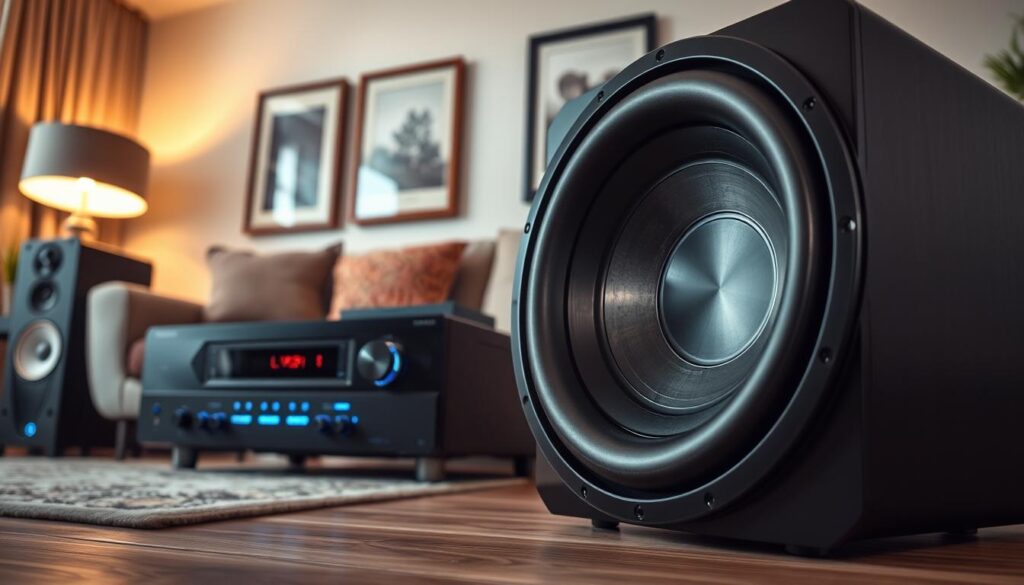
The first step is to connect your equipment properly. If you have an AV receiver, connect your Subwoofer to the LFE or Subwoofer Pre-Out port. Use a high-quality shielded RCA cable to keep the signal clear.
If your stereo amplifier lacks a sub-out, use high-level speaker wire inputs if available. For wireless setups, place the transmitter in a clear line of sight to avoid signal loss. Make sure cables are secure and you’ve mastered subwoofer placement to reduce room-related issues.
Adjusting Settings for Your Room
After connecting, calibrate settings for your room. Start by setting your crossover frequency around 80Hz for a smooth transition. Adjust the phase control to align sound waves from speakers and subwoofer.
Set volume levels gradually from your main seating position. Avoid high gain to prevent muddy or distorted sound. Fine-tuning these settings takes patience, but it leads to balanced sound.
| Setting | Purpose | Recommended Starting Point |
|---|---|---|
| Crossover | Frequency cutoff point | 80Hz |
| Phase | Wave alignment | 0 degrees |
| Volume/Gain | Output intensity | Mid-point (12 o’clock) |
| LFE Level | Low-frequency effects | 0dB (Neutral) |
Common Setup Mistakes to Avoid
Even pros can make common mistakes. One big error is using too much gain, which can overwhelm your system. Always check for loose cables to avoid buzzing or signal loss.
Also, make sure ports are not blocked by furniture or walls. This can harm performance. Lastly, never place your unit where cables are under tension, as this can damage hardware over time.
Popular Subwoofer Models Reviewed
Choosing the right subwoofer is key for deep, immersive sound. We’ve looked at several top picks to help you buy subwoofer that fits your needs and budget.
Best Budget Subwoofers
The Rogersound Labs Speedwoofer 10E is a top pick for those on a budget. It’s perfect for movie lovers who want great bass without spending a lot.
- Excellent output for home theater applications.
- Compact footprint suitable for smaller living rooms.
- High-quality construction that defies its price point.
Mid-Range Options with Great Features
The Rogersound Labs 10S MKII is a top subwoofer in the mid-range. It offers both musical accuracy and powerful sound for movies.
It’s great for those who love both music and movies. Its design fits well into most home audio setups.
High-End Models for Ultimate Performance
For the best, SVS has a range of high-end options. The right powerful subwoofer depends on your room size and sound levels.
Think about whether a sealed or ported design fits your space. Sealed units offer tighter bass, while ported designs are better for bigger rooms.
| Model Category | Primary Use | Key Strength |
|---|---|---|
| Budget | Movies | Value |
| Mid-Range | Mixed Media | Versatility |
| High-End | Home Theater | Deep Extension |
The best subwoofer for your home matches your speakers. By choosing from these top subwoofers, you get the deep sound you want.
Enhancing Your Audio Experience with a Subwoofer
Adding a subwoofer to your home audio setup changes how you hear sound. It adds depth and texture that regular speakers can’t match. This way, you get a balanced sound that makes every sound come alive.
Combining Subwoofers with Surround Sound
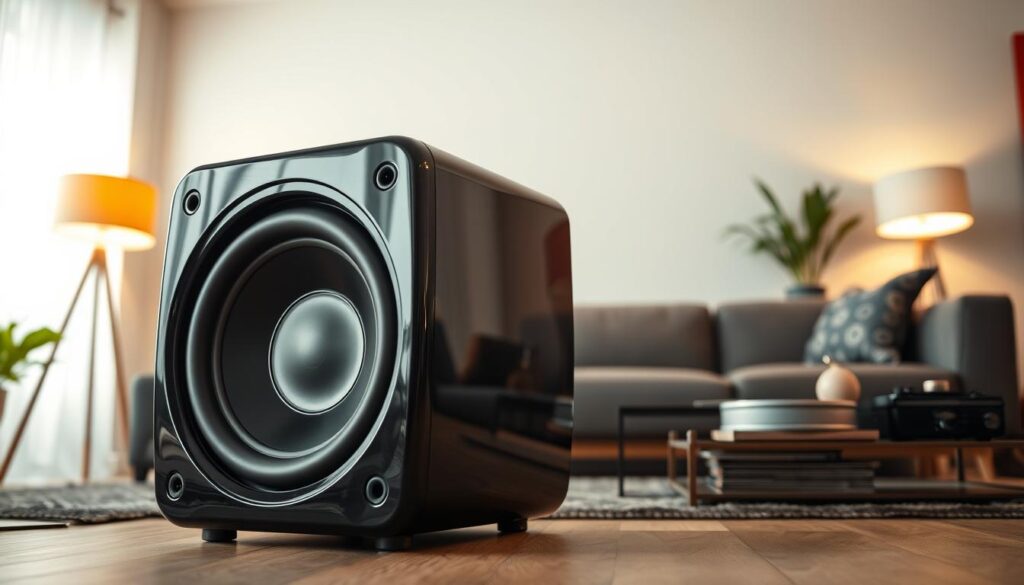
A good subwoofer for home theater systems is key. It handles the low sounds that make surround sound real. When speakers and sub work together, you get a smooth mix of sounds.
Calibration is important to avoid too much bass. Use your receiver’s software to get everything in sync. This makes your subwoofer sound system feel real and immersive.
The Impact on Music, Movies, and Gaming
A powerful subwoofer changes how you enjoy media. In movies, it brings the sound of big scenes and quiet moments to life. For music fans, it brings back the beat and rhythm of drums and bass.
Gamers also see big benefits. Better sound means you can feel the game world more. This makes gaming more fun and immersive.
Setting the Right Audio Preferences
Getting the best sound needs the right settings. Don’t just turn up the volume too high. Instead, find a balance that sounds clear and comfortable in your room.
Use different modes for different activities. For movies, LFE mode is best. It sends bass to your sub. On some models, like the Speedwoofer 10S MKII, LFE mode can make low bass 6 decibels louder. This makes music sound richer without needing to turn it up too high. Try different music modes to find the best sound for your favorite songs.
Maintenance and Care for Your Subwoofer
Keeping your sound system in top shape ensures you enjoy deep, immersive bass for years to come. These units are built to be robust but still need regular attention. By following a few simple habits, you can protect your investment from common environmental hazards.
Cleaning Tips to Ensure Longevity
Dust is the primary enemy of any subwoofer. Over time, particles can settle on the driver cone or block the ventilation ports, leading to overheating. We recommend using a soft, dry microfiber cloth to wipe down the exterior cabinet weekly.
For the driver itself, use a gentle brush or a can of compressed air to remove debris from the crevices. Always ensure that your wired subwoofer has adequate airflow by keeping it at least six inches away from walls. Avoid placing heavy objects on top of the unit, as this can cause unwanted vibrations and potential cabinet damage.
Troubleshooting Common Issues
If you notice a persistent hum or intermittent output, do not panic. Often, these problems stem from simple ground loops or loose connections rather than hardware failure. Check that all cables are firmly seated and that your power source is properly grounded.
If you experience distortion or weak bass, verify your crossover settings and gain levels. For those using wireless models, interference from other household electronics is a frequent culprit. Try changing the wireless channel or moving the transmitter to a more open location before assuming the unit is broken.
When to Consider Upgrading
Sometimes, even the best maintenance cannot overcome the limitations of an aging system. If you find yourself constantly adjusting settings to compensate for a lack of depth, it may be time to invest in a high-quality subwoofer. Modern models offer advanced features like room correction software and app-based control that older units simply lack.
Upgrading is also a smart move if your current setup no longer fills your room with the impact you desire. A high-quality subwoofer with a more robust cabinet design will provide cleaner, more accurate sound. Consider the following table to help you decide if your current gear is still meeting your needs.
| Feature | Basic Model | Premium Upgrade |
|---|---|---|
| Room Correction | Manual Only | Automated DSP |
| Control Interface | Physical Knobs | App/Remote Control |
| Output Quality | Standard | High-Excursion/Low Distortion |
| Connectivity | Wired Only | Wired & Wireless |
Customer Reviews: What Users Are Saying
Finding the right sound means weighing expert reviews against personal experiences. Technical data gives a starting point, but real-world performance can vary. It’s important to sift through opinions to uncover the truth about top subwoofers.
Insights from Audio Enthusiasts
Audio fans look for how a subwoofer fits into their setup. They say a high-quality subwoofer should blend with the speakers, not stand out as a loud box.
“The Speedwoofer 10S MKII sounds like a seamless extension of the rest of the system, delivering tuneful, musical bass that never feels forced or overwhelming.”
They value sound that’s clear and in time. This is what makes a high-quality subwoofer in a home setting.
Professional Reviews and Expert Opinions
Experts test in controlled settings, using tools to measure performance. They check frequency response, distortion, and output to rank top subwoofers.
Yet, they note that results can differ in real homes. Use their reviews to see a sub’s technical potential. But remember, your setup might change how it sounds.
Real-World Experiences with Popular Models
Home performance often deviates from lab tests. Several factors affect sound quality:
- Room Acoustics: Room size and shape can affect sound waves.
- Placement: Small changes in subwoofer position can alter sound.
- Crossover Settings: Blending speaker and sub frequencies is crucial.
- System Matching: Your entire audio setup impacts sound quality.
The best strategy is to mix expert advice with user feedback. This way, you can choose based on your listening habits and room.
Where to Buy the Best Subwoofer in the US
Before buying, plan carefully. Check your room size and amp to make sure it fits. This ensures your new subwoofer works well with your setup.
Top Online Retailers for Selection and Price
Crutchfield and Amazon have lots of options and good prices. They also have user reviews and clear return policies. This helps protect your purchase.
Some models, like the Rogersound Labs Speedwoofer 10S MKII, are only sold on the manufacturer’s site. They’re popular, so they might be out of stock.
Local Stores with Expert Advice
Local audio shops let you hear equipment before buying. The experts there can help with room setup and installation. They know the local market and can guide you to the right choice.
Seasonal Sales and Discounts to Watch For
Big sales happen during holidays like Black Friday. Keep an eye on your favorite subwoofers during these times. This way, you can get a great deal.
Always check the warranty and shipping costs before buying online. This ensures you’re making a smart choice for your home theater or music system.